2000 British Grand Prix: Rubens Barrichello Secures Ferrari Pole
On April 22, 2000, Rubens Barrichello mastered a rain-soaked Silverstone to take pole position for Ferrari, marking a classic V10 era moment.
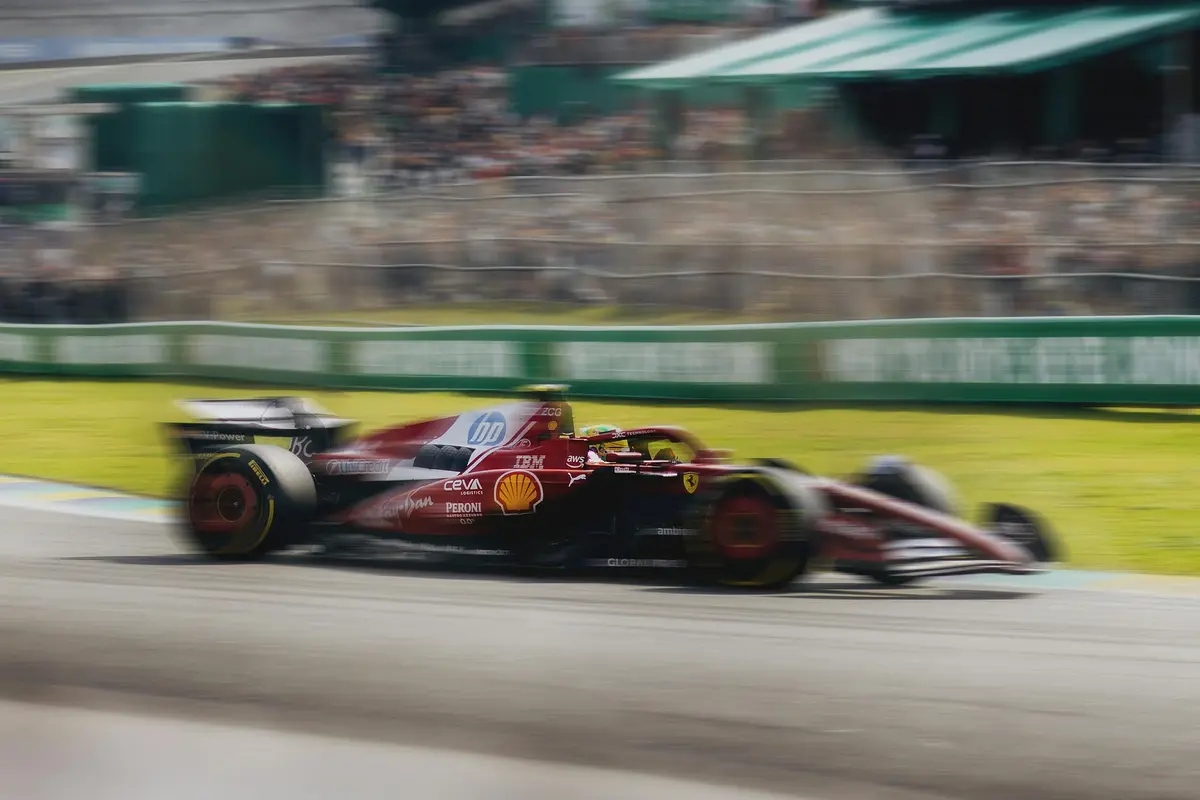
On This Day, April 22, 2000, Rubens Barrichello delivered a masterful performance in a rain-affected qualifying session to claim pole position for the British Grand Prix. Driving the Ferrari F1-2000, Barrichello navigated a treacherous, sodden Silverstone circuit to outpace Heinz-Harald Frentzen and Mika Häkkinen, signaling his arrival as a front-runner for the Scuderia during the height of the V10 era.
The April Experiment: Silverstone in the Cold
The year 2000 brought a radical change to the Formula 1 calendar. Traditionally held in the height of the British summer, the FIA moved the British Grand Prix to April, coinciding with Easter weekend. The logic was to balance the schedule, but the reality was a logistical nightmare that has since become legendary in Grand Prix history. As the paddock arrived for the qualifying session on April 22, the typical British spring had turned the infield into a quagmire. The race weekend was defined by grey skies, biting winds, and the constant threat of a deluge—a far cry from the sun-baked tarmac of the July races of the 1990s.
Despite the meteorological challenges, the atmosphere was electric. This was the peak of the Ferrari versus McLaren war. Michael Schumacher and Mika Häkkinen were locked in a titanic struggle for supremacy, but on this Saturday afternoon, it was the 'supporting cast' that would steal the limelight. For Rubens Barrichello, who had joined Ferrari at the start of the season to replace Eddie Irvine, this was the moment he needed to prove he was not merely a 'number two' driver to the great Michael Schumacher.
Qualifying Narrative: Rubens Masterclass at a Saturated Silverstone
Under the rules of the time, drivers were limited to twelve laps during a single one-hour qualifying session. With the track drying slightly after morning rain, timing was everything. The tactical battle between the pit walls was as intense as the driving on track. Bridgestone, the sole tyre supplier at the time, had brought their grooved tyres, which were mandatory since the 1998 season to limit cornering speeds. Managing these grooves on a damp but drying surface required delicate throttle control—a specialty of the Brazilian drivers who grew up racing in tropical downpours.
As the session progressed, the Jordan EJ10 of Heinz-Harald Frentzen looked formidable. The Mugen-Honda V10 engine was producing incredible power, and Frentzen, a master of variable conditions, sat atop the timing screens for much of the hour. However, in the dying minutes, Rubens Barrichello took his Ferrari F1-2000 out for a final flyer. While his teammate Michael Schumacher struggled with the balance of his car in the low-grip conditions, Barrichello found a rhythm through the high-speed Maggotts and Becketts complex. He crossed the line with a 1:25.703, a massive three-tenths of a second faster than Frentzen. The McLaren MP4/15 of Mika Häkkinen could only manage third, followed by his teammate David Coulthard. It was Barrichello’s third career pole, but his first for the Prancing Horse, sending the Tifosi into a frenzy despite the biting cold.
Technical Deep Dive: The Ferrari F1-2000 vs. The McLaren MP4/15
The 2000 season was a technological arms race of the highest order. The Ferrari F1-2000, designed by Rory Byrne and Ross Brawn, was a significant evolution over the previous year’s F399. The car featured a lower center of gravity and a new engine, the Type 049 90-degree V10. This 3.0-liter masterpiece produced approximately 800 brake horsepower and screamed at nearly 18,000 RPM. One of the key advantages of the F1-2000 was its aerodynamic stability; it was less sensitive to pitch than the McLarens, which made it far more predictable on the bumpy, windswept planes of an old airfield like Silverstone.
In contrast, the Adrian Newey-designed McLaren MP4/15 was arguably the fastest car in a straight line, but it was temperamental. It utilized the Mercedes-Benz FO110J V10 engine, which was rumored to be the lightest in the field. However, McLaren was under scrutiny due to their use of Beryllium alloys in the engine construction—a material the FIA would eventually ban due to health risks, but was still legal through the end of 2000. On April 22, the MP4/15’s superior top speed was negated by the lack of mechanical grip in the wet, allowing the well-balanced Ferrari of Barrichello to exploit the technical nuances of the circuit.
The 'Mudbath' and the Fan Experience
While the action on track was world-class, the situation for the spectators was dire. The heavy rain on Friday and Saturday morning had turned the grass car parks into swamps. Thousands of fans found themselves stranded, their cars submerged in mud up to the axles. The organizers eventually had to take the unprecedented step of telling fans to stay away on Saturday unless they were already on-site. This decision cast a shadow over the event, but for those who made it to the grandstands, the sight of the V10 engines spitting fire on downshifts through Abbey chicane was a visceral experience that modern racing lacks.
The era of 2000 was the final chapter of the 'analogue-to-digital' transition. While cars featured semi-automatic gearboxes and sophisticated engine mapping, they still required immense physical effort to drive. There were no driver aids like power steering on many cars, and the grooved tyres made the cars nervous and twitchy. To see Barrichello wrestling the Ferrari through Bridge and Luffield was a testament to the raw talent required in this period of the sport.
Aftermath and the Legacy of the 2000 Season
Barrichello’s pole on April 22 did more than just set him up for the race; it solidified his status within the team. Although the race on Sunday would ultimately be won by David Coulthard, with Barrichello suffering a mechanical failure while leading, the qualifying session remained a high-water mark. The 2000 season would eventually see Michael Schumacher claim his first world title for Ferrari, ending a 21-year drought for the team. Barrichello’s contribution, starting with this pole position at Silverstone, was vital in securing the Constructors' Championship.
Historically, the 2000 British Grand Prix serves as a reminder of why the race was never again held in April. The logistical chaos forced a permanent move back to the summer months. For historians, however, the images of the red Ferraris and silver McLarens cutting through the mist of a cold Northamptonshire afternoon remain some of the most evocative of the V10 era. It was a time of pure mechanical grit, where a driver's feel for the limit was the only thing standing between a pole position and a trip into the gravel trap.
Key Takeaways from the 2000 British Grand Prix Weekend
- Barrichello's Breakthrough: Rubens Barrichello secured his first pole for Ferrari, out-qualifying Michael Schumacher in identical machinery.
- Technical Supremacy: The Ferrari F1-2000's Type 049 V10 proved its versatility in low-grip, high-downforce conditions.
- The Weather Factor: The decision to hold the race in April led to the infamous 'Silverstone Mudbath,' a logistical disaster for the sport.
- V10 Soundscape: The 2000 season represented the peak of naturally aspirated V10 development, with engines reaching nearly 18,000 RPM.
- Grooved Tyre Era: The performance highlighted the difficulty of managing the four-groove tyre regulations on a drying track.
Frequently Asked Questions
Who won the 2000 British Grand Prix?
While Rubens Barrichello took pole on April 22, the race on April 23 was won by David Coulthard in the McLaren MP4/15, followed by his teammate Mika Häkkinen and Michael Schumacher.
Why was the race held in April?
The FIA moved the race to April to accommodate a reshuffled calendar, but the move was abandoned in subsequent years due to the severe weather and logistical issues at Silverstone.
What engine did the Ferrari F1-2000 use?
The car was powered by the Ferrari Type 049 V10 engine, a 3.0-liter unit that was lighter and more powerful than its predecessor, the 048.
Conclusion
The events of April 22, 2000, encapsulate a specific, gritty era of Formula 1. It was a time when the sport was defined by the shrieking melody of V10 engines and the intense rivalry between two of the greatest teams in history. Rubens Barrichello’s pole position was a triumph of skill over circumstance, proving that even in the shadow of a giant like Michael Schumacher, talent could shine through. As we look back on this day in history, we remember not just the mud and the cold, but the raw, unshielded power of a Ferrari at full tilt through the English countryside. The 2000 British Grand Prix remains a cornerstone of the Golden Era, a final glimpse of the sport before it transitioned into the more regulated and sanitized version we see in the later decades. For the historian, Barrichello’s lap stands as a monument to the spirit of the millennium racers.
#F1 #F1History #BringBackV10s #TifosiIn this article
Written with AI assistance. How this site works