Nigel Mansell 1992 Spanish Grand Prix: A Masterclass in the Rain
On April 26, 1992, Nigel Mansell won a rain-soaked Spanish Grand Prix in the iconic Williams FW14B, marking his fourth straight win of the season.
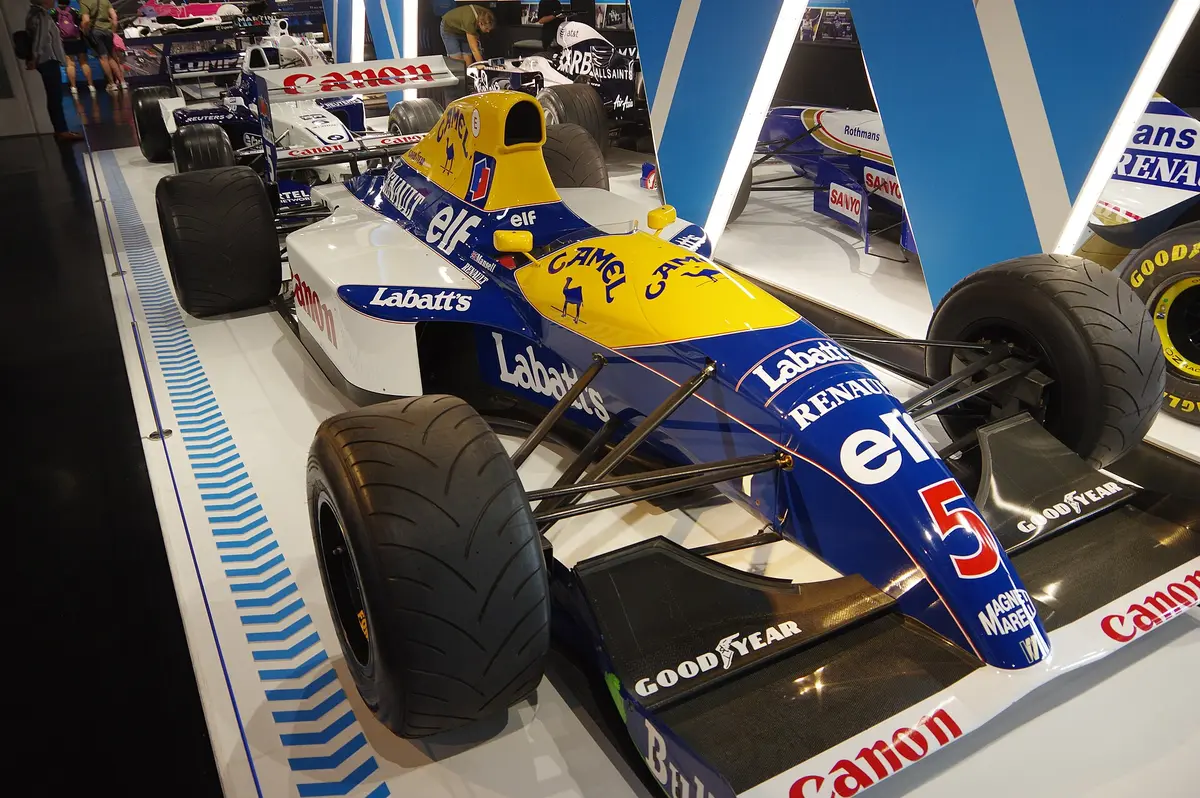
On This Day: On April 26, 1992, Nigel Mansell delivered a dominant performance at the Spanish Grand Prix in Barcelona, securing his fourth consecutive victory of the 1992 season. Driving the technologically superior Williams FW14B in torrential rain, Mansell outclassed the field, finishing ahead of rising star Michael Schumacher and Ferrari's Jean Alesi.
The Dawn of the Active Era in Barcelona
The 1992 Formula 1 season is often remembered as the moment the sport underwent a digital revolution. At the heart of this transformation was the Williams FW14B, a car so advanced it was frequently described as being from another planet. On April 26, 1992, the paddock arrived at the Circuit de Barcelona-Catalunya for the fourth round of the championship. Nigel Mansell had already swept the first three races in South Africa, Mexico, and Brazil. The atmosphere was thick with anticipation—and soon, heavy with storm clouds. This was only the second time the Grand Prix had been held at the Montmeló circuit, and the technical demands of the track were about to be magnified by a brutal Catalan deluge. Heading into the weekend, the narrative was centered on whether anyone could stop the 'Red 5.' Nigel Mansell was in the form of his life, possessing a symbiotic relationship with the Adrian Newey-designed chassis. The FW14B featured a highly sophisticated active suspension system that allowed the car to maintain an optimal aerodynamic platform regardless of the bumps or load changes. In an era before modern electronic restrictions, this was the pinnacle of mechanical and electronic integration. While rivals like Ayrton Senna in the McLaren MP4/7A struggled to adapt their chassis to the new V12 Honda power units, Williams was operating in a league of their own.Qualifying: The Red 5 Extends His Reign
During the qualifying sessions, the sheer pace of the Williams-Renault package was frightening. Nigel Mansell took pole position with a time of 1:23.244, nearly a full second faster than his teammate Riccardo Patrese. To put that into perspective, Michael Schumacher, driving the Benetton B192, was over 1.5 seconds adrift in third. Ayrton Senna, the reigning world champion, found himself languishing in seventh place on the grid, highlighting the massive struggle McLaren-Honda was facing to keep pace with the Grove-based outfit. The qualifying hour was a display of raw power and aerodynamic efficiency. The Renault RS4 3.5-liter V10 engine provided a broad powerband that complemented the FW14B's active ride. As the cars screamed down the 1.047km main straight, the difference in stability was visible to the naked eye. While the Ferraris of Jean Alesi and Ivan Capelli bucked and moved over the surface, Mansell’s Williams remained eerie in its composure, a testament to the complex hydraulic actuators managing the car's height at every corner.Technical Marvel: Inside the Williams FW14B
To understand Nigel Mansell 1992, one must understand the machine. The FW14B was not merely an evolution of the previous year's car; it was a refined weapon. The active suspension, pioneered by Paddy Lowe and the engineering team, utilized a system of sensors that measured the load on each wheel, the car's pitch, and its roll. This data was processed by an onboard computer that adjusted the hydraulic fluid in the struts to keep the car perfectly level. This meant the front wing was always at the perfect distance from the tarmac to generate maximum downforce without the car bottoming out. Coupled with this was a semi-automatic gearbox—a technology Ferrari had introduced in 1989 but Williams had now perfected—and a primitive form of traction control. In the soaking wet conditions of April 26, these systems would prove invaluable. While other drivers were fighting to keep their rear wheels from spinning and their cars from aquaplaning, Nigel Mansell was able to lean on the technology to find grip where others found only grease. The Renault V10 engine also played a crucial role; its reliability and fuel efficiency were superior to the thirsty Honda V12, allowing the Williams drivers more flexibility in their race strategy.Race Narrative: Survival in the Catalan Deluge
As the green light flickered on Sunday, the heavens opened. The track was quickly saturated, turning the 4.7-kilometer circuit into a treacherous river of asphalt. Nigel Mansell got a clean start from pole, but his teammate Riccardo Patrese was immediately swamped by the fast-starting Michael Schumacher and the McLarens. The visibility was near zero, with the Goodyear rain tyres throwing up massive plumes of spray that blinded anyone following in the pack. Despite the conditions, Mansell began to pull away with rhythmic precision. By the end of the first lap, he had already carved out a significant gap. Behind him, the battle for survival was intense. Michael Schumacher, in only his first full season of Formula 1, was demonstrating the wet-weather prowess that would later earn him the nickname 'Regenmeister.' He pushed his Benetton B192 to the limit, hounding Patrese and eventually moving into second place when the Italian spun his Williams while trying to navigate the traffic of backmarkers. The race became a test of endurance and concentration. The manual gear shifts of the lower-tier cars were a nightmare in the wet, but even for the top teams, the threat of aquaplaning was constant. Ayrton Senna, usually the master of these conditions, was visibly struggling. The McLaren MP4/7A was heavy and lacked the sophisticated balance of the Williams. Senna spent much of the race engaged in a fierce battle with Michael Schumacher and the Ferrari of Jean Alesi. The Ferrari F92A, despite its 'double-bottom' floor being an aerodynamic failure in the dry, seemed surprisingly compliant in the wet, allowing Alesi to claw his way up the order.The Rise of the Rain Master: Schumacher’s Pursuit
As the race crossed the halfway mark, the intensity of the rain fluctuated. Nigel Mansell remained unchallenged at the front, but the gap between him and Michael Schumacher began to stabilize. This was a significant moment in F1 history—the veteran lion being chased by the young protégé. Schumacher’s Benetton was using a more conventional suspension setup compared to the Williams, yet his car control was exemplary. He was taking lines through the corners that no one else dared, seeking out the grip on the outside edges of the track. However, Nigel Mansell 1992 was a force of nature. Every time Schumacher appeared to be making a dent in the lead, Mansell would respond with a fastest lap, pushing his Renault engine to the limit. The sound of the V10 echoing off the grandstands, muffled only by the sound of falling water, was a symphony of the mechanical era. Mansell’s steering inputs were minimal; he trusted the FW14B to find the road, using his legendary upper-body strength to muscle the car through the heavy steering loads caused by the standing water.Heartbreak for Senna and the Tifosi's Joy
With just a few laps remaining, the drama spiked. Ayrton Senna, running in a podium position and trying to fend off a charging Jean Alesi, suffered a devastating spin. The McLaren clipped a puddle and pirouetted into the gravel trap. It was a rare mistake from the Brazilian, marking a low point in a season that was rapidly slipping away from him. This promoted Alesi to third place, bringing a much-needed smile to the faces of the Ferrari mechanics and the Tifosi in the stands. Nigel Mansell took the chequered flag after 65 grueling laps, finishing 23 seconds ahead of Michael Schumacher. It was a statement victory. Not only had he won four out of four, but he had done so in the most challenging conditions possible, proving that while his car was a masterpiece, the man behind the wheel was equally formidable. The podium featured three generations of F1 talent: the established superstar Mansell, the future legend Schumacher, and the spirited Alesi.Aftermath and Championship Trajectory
The victory on April 26, 1992, put Nigel Mansell in a commanding position in the World Drivers' Championship. With 40 points out of a possible 40, the title seemed like a formality even in April. The dominance of the Williams FW14B led to whispered frustrations in the paddock, with rival teams realizing they were effectively a year behind in electronic development. This race cemented the 1992 season as the year of 'Mansell Mania,' a period where the British public and F1 fans worldwide were captivated by the sheer speed of the 'Red 5.' For Michael Schumacher, the second-place finish was a validation of his talent. It was his best result to date and signaled to the world that the post-Senna era would likely belong to him. For Ferrari, Alesi’s podium was a rare highlight in a season plagued by the unreliability and poor performance of the F92A. However, the day belonged to Nigel Mansell. His performance in Barcelona remains one of the definitive wet-weather drives of the 1990s, showcasing the perfect marriage of human bravery and cutting-edge engineering.- Nigel Mansell became the first driver in history to win the opening four races of a season.
- The victory was Mansell's 25th career win, moving him past Jim Clark's British record.
- The race highlighted the massive performance gap created by the Williams FW14B’s active suspension.
- Michael Schumacher’s second place was his third podium in his first full season of F1 racing.
- Ayrton Senna’s late spin resulted in his second retirement of the 1992 season.
Frequently Asked Questions
What made the Williams FW14B so dominant in 1992? The car featured a suite of 'driver aids' that were ahead of their time, most notably an active suspension system that kept the car at a constant ride height, maximizing aerodynamic downforce. It also utilized traction control and a highly efficient Renault V10 engine. Was the 1992 Spanish Grand Prix the first race at Barcelona? No, it was the second. The first Spanish Grand Prix at the Circuit de Barcelona-Catalunya took place in 1991, famously known for the wheel-to-wheel battle between Nigel Mansell and Ayrton Senna down the main straight. How did Nigel Mansell win the 1992 title? Mansell went on to win a total of nine races in 1992, clinching the World Drivers' Championship at the Hungarian Grand Prix in August, with five races still remaining in the season.Conclusion
The 1992 Spanish Grand Prix was more than just a race; it was a demonstration of the changing guard in Formula 1. As the rain lashed down on the tarmac of Montmeló, Nigel Mansell showed that he was the undisputed king of the new electronic frontier. The image of the yellow and blue Williams cutting through the spray, its Renault V10 screaming at 14,000 RPM, remains one of the most iconic sights of the 1990s. While technology played a massive role, the grit required to navigate such conditions for nearly two hours cannot be understated. Nigel Mansell 1992 was a season of perfection, and April 26 was perhaps its most challenging chapter. Looking back from the perspective of F1 history, this race stands as a testament to an era where mechanical ingenuity and driver courage collided to produce something truly spectacular. #F1 #F1History #BringBackV10s #F1TechIn this article
Written with AI assistance. How this site works