Alain Prost Wins 1993 San Marino GP at Imola
On April 25, 1993, Alain Prost led a Williams-Renault masterclass at Imola, showcasing the unmatched technical power of the active-suspension FW15C.
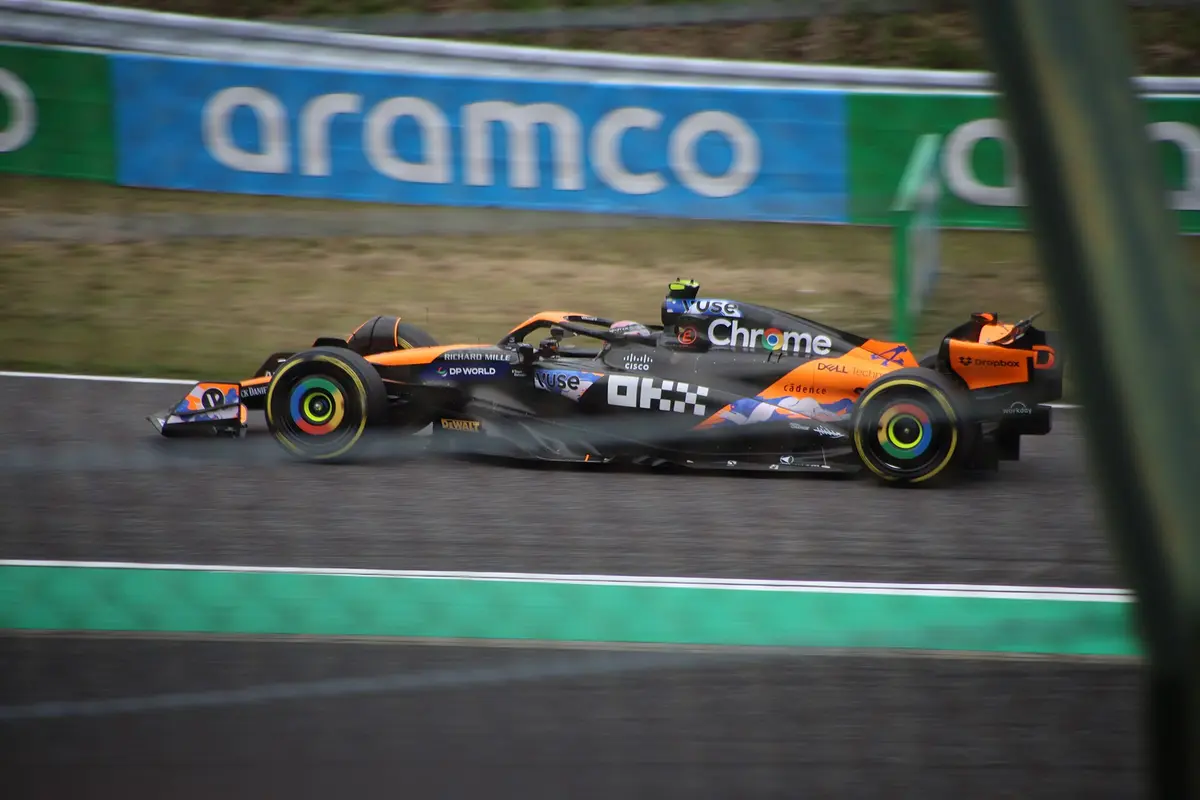
Photo: Cineyas / CC-BY-SA-4.0
On This Day in 1993, Alain Prost secured a dominant victory at the San Marino Grand Prix driving the technologically advanced Williams-Renault FW15C. This race at Imola highlighted the era's technical peak, featuring active suspension and traction control, while cementing Prost's championship lead over rival Ayrton Senna in a tactical masterpiece of 1990s racing logic.
The Dawn of the High-Tech Masterpiece
The 1993 Formula 1 season is often remembered as the pinnacle of the electronic era, a time when the mechanical soul of the sport was augmented by the most sophisticated driver aids ever conceived. At the heart of this revolution was the Williams-Renault FW15C, a car that remains, even decades later, one of the most technologically advanced racing machines to ever turn a wheel. Designed by Adrian Newey and Patrick Head, the FW15C featured active suspension, traction control, anti-lock brakes, and a semi-automatic gearbox that made it the class of the field. On April 25, 1993, the circus arrived at the Autodromo Enzo e Dino Ferrari in Imola, a circuit that demanded both high-speed stability and mechanical grip through its undulating landscape. Alain Prost, returning to the sport after a forced sabbatical in 1992, was on a mission to secure his fourth World Championship. Despite the immense speed of the Williams-Renault package, the start of the 1993 season had not been entirely smooth for the Frenchman. His arch-rival, Ayrton Senna, driving the underpowered but nimble McLaren MP4/8, had snatched victories in Brazil and Donington Park, utilizing his legendary rain-mastery to overcome the technical deficit of his Ford HB V8 engine. As the teams set up in the Imola paddock, the pressure was firmly on Alain Prost to convert the Williams’ theoretical advantage into a concrete result on Italian soil.
Qualifying: The Williams Front-Row Lockout
Friday and Saturday at Imola served as a stark reminder of the gap between the 'haves' and the 'have-nots' in the 1993 pit lane. The Williams FW15C, powered by the glorious 67-degree Renault RS5 V10 engine, was in a league of its own during qualifying. Alain Prost claimed pole position with a blistering lap of 1:22.070, nearly half a second clear of his teammate Damon Hill. To put the Williams' dominance into perspective, Michael Schumacher, qualifying third in the Benetton B193B, was a staggering 1.8 seconds adrift of Prost's time. Ayrton Senna, who usually pulled miracles out of the bag during qualifying, found himself relegated to fourth on the grid. The McLaren MP4/8 was equipped with its own suite of electronics, but the Ford customer engine lacked the sheer horsepower required to challenge the Renault V10 on Imola’s long blasts toward Tosa and Piratella. The Tifosi, meanwhile, were left largely disappointed; the Ferrari F93A, despite its beautiful V12 soundtrack, was plagued by an unrefined active suspension system that made it a handful for Jean Alesi and Gerhard Berger, who could only manage 7th and 10th respectively. The qualifying session was a clear indication that while the driver’s skill remained paramount, the 1993 season was becoming a battle of software and hydraulic actuators as much as pistons and valves.
Race Narrative: A Tactical Battle at Imola
When the lights turned green on Sunday afternoon, the script was immediately thrown out the window. Damon Hill, in just his fourth race for Williams, got a superior launch compared to Alain Prost. As they plummeted toward the Tamburello curve—then a high-speed left-hander—Hill surged into the lead. Behind them, Ayrton Senna demonstrated his legendary starting prowess, leapfrogging Michael Schumacher and pressuring Alain Prost through the Villeneuve chicane. For the opening laps, the race was a high-speed chess match. Damon Hill led comfortably, showing the poise of a seasoned veteran rather than a newcomer, while Alain Prost found himself tucked in behind his teammate, seemingly biding his time. The race took a dramatic turn for the championship leader, Ayrton Senna, on lap 8. The McLaren MP4/8 began to suffer from hydraulic issues, a common ailment in the complex cars of 1993. Senna’s active suspension failed, causing the car to bottom out and lose grip. Eventually, the Brazilian was forced to retire, handing a massive advantage to the Williams duo. With Senna out of the picture, the focus shifted to the battle between the two Williams drivers. Alain Prost, known as 'The Professor' for his calculating approach, did not panic when he lost ground at the start. He knew that the 61-lap race at Imola was a test of endurance and tire management. On lap 11, the order shifted. Alain Prost utilized the superior top-end power of the Renault V10 to close the gap to Damon Hill. As they approached the Tosa hairpin, Prost executed a clinical overtake to reclaim the lead. From that point forward, the Frenchman was in his element. He began to set a sequence of fastest laps, opening a gap that the rest of the field simply could not bridge. Damon Hill’s afternoon, however, would end in heartbreak. On lap 21, while running in a solid second place, the younger Briton suffered a brake failure, sending his Williams FW15C into the gravel and out of the race. This left Alain Prost with a cavernous lead over Michael Schumacher’s Benetton.
The Technical Mastery of the FW15C
To understand Alain Prost’s dominance on April 25, 1993, one must look at the telemetry of the era. The Williams FW15C utilized a system that constantly adjusted the ride height of the car at all four corners. In the heavy braking zones like Rivazza, the car would remain perfectly level, preventing the nose-dive that traditionally destabilized a Formula 1 car. Through high-speed bends like the Curva di Alta, the active system would lower the car to maximize ground effect, creating immense downforce without the penalty of drag on the straights. Alain Prost, more than any other driver, mastered the art of trusting these electronic systems. While Schumacher in the Benetton B193B was wrestling with a car that felt lively and physical, Prost looked as though he was on a Sunday drive, his inputs smooth and economical. As the race entered its final stages, the mid-field was decimated by reliability issues. The Ferrari of Jean Alesi had already retired with a spectacular engine failure, much to the chagrin of the Italian crowd. Gerhard Berger followed suit shortly after. This left the podium battle to Michael Schumacher and the Lotus-Ford 107B of Johnny Herbert. Schumacher, driving with the aggressive style that would soon define the mid-90s, held onto second place despite a late-race spin. Alain Prost eventually crossed the line over 32 seconds ahead of the young German, marking his 47th career victory and reclaiming the lead in the World Drivers' Championship.
Aftermath and Legacy of the 1993 San Marino GP
The 1993 San Marino Grand Prix was a watershed moment for the season. It proved that when the Williams FW15C was running reliably, it was virtually untouchable. Alain Prost’s victory at Imola broke Ayrton Senna’s early-season momentum and set the stage for Prost’s fourth and final world title. For Michael Schumacher, the second-place finish was another brick in the wall of his growing reputation; he was the only driver capable of keeping the dominant Williams cars within even remote sight. The race also marked a high point for Lotus, with Johnny Herbert’s fourth-place finish providing a glimpse of hope for the legendary team that was unfortunately nearing its end. However, the legacy of the 1993 San Marino GP is also tied to the debate over technology. The ease with which the Williams cars dominated led the FIA to announce a ban on electronic driver aids for the 1994 season. Critics argued that the 'computer cars' had taken too much away from the driver's influence. While Alain Prost's skill was undeniable, the sheer technical disparity seen at Imola on April 25, 1993, spurred a movement to return the sport to a more mechanical, 'raw' state. This race stands as a monument to the brief window in F1 history where the limits of aerospace-grade technology and automotive engineering were pushed to their absolute breaking point.
Key Takeaways from Imola 1993
Alain Prost's Dominance: The Frenchman secured his 47th win and took a crucial step toward his 4th World Championship.
Technological Peak: The Williams FW15C showcased the pinnacle of active suspension, outclassing the field by over 30 seconds.
Schumacher's Rise: Michael Schumacher’s 2nd place finish solidified his status as the primary challenger to the established order of Prost and Senna.
Senna's Struggle: The retirement of Ayrton Senna highlighted the reliability risks associated with the high-tech 1993 machinery.
The End of an Era: This race contributed to the eventual FIA decision to ban electronic aids, making 1993 the final year of the 'Electronic Age.'
Frequently Asked Questions
Who won the 1993 San Marino Grand Prix?
Alain Prost won the race driving the Williams-Renault FW15C. It was his second victory of the 1993 season and the 47th of his illustrious career.
What happened to Ayrton Senna during the race?
Ayrton Senna retired on lap 8 due to a hydraulic failure in his McLaren MP4/8, which affected the car's active suspension and transmission systems.
Why was the Williams FW15C considered so much faster than other cars?
The FW15C featured a highly advanced active suspension system that optimized aerodynamics in real-time, combined with the most powerful engine of the era, the Renault RS5 V10.
How many laps was the 1993 San Marino Grand Prix?
The race consisted of 61 laps around the 5.040 km Autodromo Enzo e Dino Ferrari circuit in Imola, Italy.
Conclusion: A Masterclass in the Golden Era
Reflecting on the events of April 25, 1993, we see a snapshot of a sport at a crossroads. The battle at Imola was not just between men, but between philosophies of engineering. Alain Prost’s victory was a testament to his ability to adapt to the changing landscape of Grand Prix racing, moving from the manual gearboxes and raw turbos of the 1980s to the computer-managed precision of the 1990s. While some purists may have lamented the lack of wheel-to-wheel combat at the front, the 1993 San Marino Grand Prix remains a fascinatng study in technical perfection. As the V10 engines screamed through the Italian hills, the 1993 season marched toward a conclusion that would see one legend retire at the top, and another begin his ascent to greatness. To the historian, Imola 1993 is more than just a race; it is the ultimate showcase of the mechanical and electronic synergy that defined the final years of the 20th century in Formula 1. #F1 #F1History #BringBackV10s #ProstTheProfessor
In this article
Written with AI assistance. How this site works