McLaren MCL40 Rebuild: Stella's 'Entirely New' Car for Miami
McLaren enters the Miami Grand Prix with an 'entirely new' MCL40 after a five-week break, as team principal Andrea Stella signals sweeping upgrades and renewed optimism.
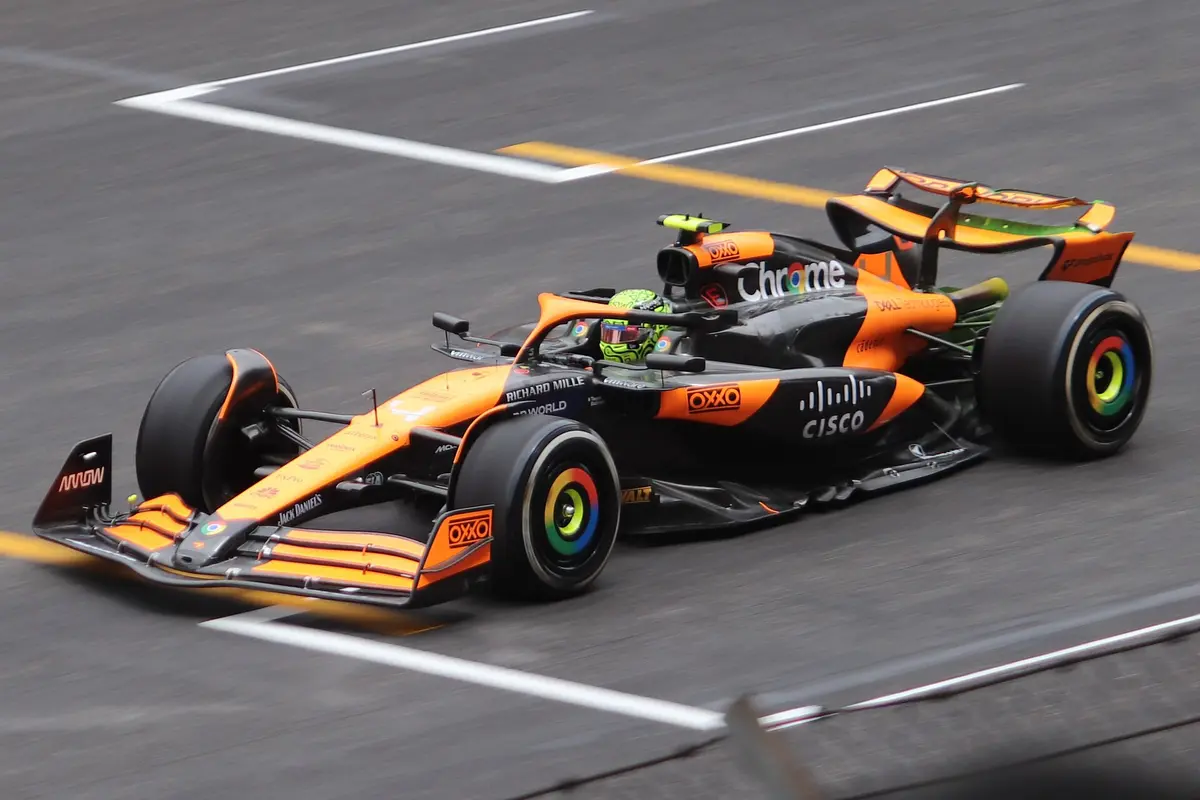
Photo: Liauzh / CC-BY-SA-4.0
McLaren arrives at the Miami Grand Prix carrying one of the most significant mid-season technical narratives of the 2026 Formula 1 campaign. Team principal Andrea Stella has described the updated MCL40 as an "entirely new" car — a striking choice of words from a team that has invested heavily in capitalising on the sweeping regulatory changes that define this era of the sport. After a five-week break that allowed the Woking-based outfit to regroup, redesign, and reload, McLaren's renewed optimism heading into Miami signals that what we are about to witness may represent a genuine inflection point in the 2026 championship battle.
The Miami Grand Prix has quickly established itself as one of the most strategically complex and atmospherically charged events on the Formula 1 calendar. For McLaren — a team that entered 2026 as one of the front-running constructor forces — the timing of this overhaul could not be more deliberate. A five-week gap between race weekends is an extraordinarily rare luxury in modern F1, and the Papaya squad has clearly used every hour of it. Whether the MCL40 rebuild translates into immediate on-track performance will be the defining question of a Miami weekend that carries enormous championship implications.
What Does 'Entirely New' Actually Mean for the MCL40?
Andrea Stella's language is deliberately emphatic. In the carefully managed world of Formula 1 communications — where engineers and team principals routinely speak in measured, hedged phrases designed to manage expectations — describing a car as "entirely new" is a bold, purposeful statement. It suggests a package of upgrades so comprehensive in scope that it transcends the typical incremental update philosophy that teams usually deploy across a race-to-race development cycle.
In the context of the 2026 regulations, this framing carries additional weight. The current technical framework — which introduced radical changes to aerodynamic philosophy and power unit architecture — has demanded that every constructor find its own interpretive path through an extraordinarily complex rulebook. Teams that misread the initial direction of the regulations have found themselves exposed, and the five-week gap in the calendar represented a critical window to either consolidate an advantage or stage a significant recovery.
For McLaren, Stella's declaration of an "entirely new" MCL40 implies that the team's Woking factory has been operating at maximum intensity throughout the break — with the wind tunnel, CFD clusters, and simulator all pointed toward a unified objective: producing a car that more completely realises the performance potential that the 2026 regulations offer. It is a signal to rivals and to the paddock at large that McLaren's development rate and resource base are not to be underestimated.
Renewed Optimism: What's Driving McLaren's Confidence?
The phrase "renewed optimism" that accompanies Stella's announcement is equally telling. It implies that, at some point prior to Miami, optimism had dimmed — that the MCL40 as it existed before this overhaul was not delivering on expectations, or at least not delivering at the rate the team believed was necessary to compete at the very front of the 2026 grid.
This is not unusual for a team navigating a major regulatory transition. In 2026, every constructor on the grid is, to some degree, still uncovering the true performance envelope of their machinery. The 2026 regulations have proven to be among the most technically demanding in the modern era, and the gap between a car that merely complies with the rules and a car that genuinely exploits them can be substantial. McLaren's willingness to declare a near-total reset of the MCL40 concept suggests the team has identified specific areas — whether aerodynamic, mechanical, or related to the integration of the new power unit regulations — where significant gains were being left on the table.
Lando Norris and Oscar Piastri, the team's driver pairing since 2019 and 2023 respectively, have both demonstrated the capacity to extract maximum performance from competitive machinery. If the revised MCL40 delivers on Stella's framing, both drivers possess the racecraft and qualifying pace to translate an improved technical platform into meaningful championship results. The question is whether the gains are as sweeping as the team's language suggests, or whether "entirely new" is a degree of optimism that the physical car must now substantiate under race conditions.
The Miami Grand Prix as a Championship Reset Point
Miami has a particular character within the Formula 1 calendar. The Hard Rock Stadium complex circuit, with its mix of high-speed sections and technical infield passages, places a premium on aerodynamic balance, tyre management, and the ability to generate consistent downforce across a variety of corner types. It is precisely the kind of venue where a fundamentally revised aerodynamic concept — if that is indeed part of what McLaren's "entirely new" car encompasses — can either shine brilliantly or expose remaining weaknesses under real-world competitive conditions.
The five-week break preceding Miami also means that rival teams — including Red Bull with Max Verstappen and Isack Hadjar, Ferrari with Charles Leclerc and Lewis Hamilton in his second year with the Scuderia, and Mercedes with George Russell and Andrea Kimi Antonelli — will also have used the extended interval to push their own development programmes forward. The Miami weekend, therefore, is not simply a test of whether McLaren's rebuilt MCL40 is faster than the car it replaced. It is a test of whether McLaren's development rate during the break exceeded that of its closest rivals.
In a 2026 championship landscape defined by the new active aerodynamic systems and revised overtake boost regulations, the pace of development across the season will likely determine the title outcome more decisively than early-season performance. A team that can execute a genuine step-change upgrade — as McLaren appears to be attempting — at a crucial juncture in the calendar has an opportunity to reframe the entire competitive narrative.
Technical and Strategic Implications for the 2026 Season
The implications of McLaren's MCL40 rebuild extend well beyond a single race weekend. From a purely strategic perspective, deploying what amounts to a fundamentally revised car at Miami — rather than, say, a more traditional European venue — suggests that the team has a high degree of confidence in the correlation between its simulation data and real-world performance. Introducing a large-scale upgrade package at a circuit with distinct characteristics is a calculated risk: the environment will stress-test the new components in conditions that may not perfectly match the team's primary simulation focus, but it also maximises the number of remaining race weekends in which the team can benefit from the upgrade if it proves successful.
From a constructor's championship standpoint, the timing is equally significant. Points accumulated in the early and middle portions of a Formula 1 season carry identical weight to those earned in the closing rounds, but the psychological momentum generated by a clear upgrade step — particularly one as comprehensively framed as Stella's description implies — can galvanise a team around a clear performance trajectory. For McLaren's engineers, mechanics, and strategists, the message from the top is unambiguous: the tools are now in place; the opportunity is here.
For rivals, Stella's public declaration will itself function as a form of strategic communication — a signal that McLaren intends to be a serious and growing force through the remainder of the 2026 campaign, and that any performance gap that may have existed before Miami cannot be assumed to persist going forward.
Key Takeaways
- McLaren team principal Andrea Stella has described the updated MCL40 as "entirely new" ahead of the Miami Grand Prix, signalling a comprehensive upgrade package.
- A five-week break in the 2026 F1 calendar provided McLaren with an extended development window that the team has visibly exploited to its fullest extent.
- Stella's framing of "renewed optimism" suggests the pre-Miami MCL40 was underperforming relative to the team's internal expectations within the 2026 regulatory framework.
- Lando Norris and Oscar Piastri remain well-positioned to convert an improved technical platform into results, given both drivers' demonstrated qualifying and race pace.
- The Miami Grand Prix serves as an important championship reset point, with all front-running teams having used the break to develop — making relative upgrade gain the key variable.
- McLaren's willingness to describe the car as entirely new publicly signals confidence in their simulation-to-track correlation and sets the tone for the second phase of the 2026 season.
Frequently Asked Questions
What did Andrea Stella mean when he called the MCL40 'entirely new' for Miami?
Stella's description indicates a package of upgrades so extensive that it effectively transforms the MCL40 into a substantially different car from the one McLaren raced before the five-week break. In Formula 1, where teams typically describe updates in incremental terms, using the phrase "entirely new" is a deliberate signal of the scope and ambition of the development work carried out during the interval. It suggests changes that go beyond surface-level aerodynamic tweaks to touch fundamental aspects of the car's concept and performance envelope.
Why is the Miami Grand Prix a significant venue for McLaren to debut a major upgrade?
Miami's circuit characteristics — combining high-speed sections with technical infield corners — provide a broad and demanding test environment that can reveal whether a revised aerodynamic and mechanical concept performs consistently across a range of demands. Deploying a large upgrade at Miami also maximises the number of remaining 2026 race weekends in which McLaren can benefit from the new package if it proves effective. The choice reflects confidence in the team's internal data.
How does the five-week break factor into McLaren's development strategy?
An extended break of five weeks is exceptionally rare in modern Formula 1 and represents a significant opportunity for any team with sufficient factory resource to execute large-scale development work. McLaren has clearly prioritised this window to prepare what Stella calls an entirely new MCL40, suggesting the Woking factory ran its design, simulation, and manufacturing departments at high intensity throughout. The break effectively handed McLaren — and all other top teams — an unusually long off-season mid-campaign.
How might the McLaren MCL40 rebuild affect the 2026 constructors' championship?
If the rebuilt MCL40 delivers performance in line with Stella's optimistic framing, McLaren could emerge from Miami with renewed momentum and a stronger development trajectory for the remainder of the season. In the 2026 regulatory environment — where active aerodynamics and revised power unit rules continue to generate a steep development curve — a genuine step-change upgrade at a mid-season juncture can reshape the championship standings significantly. However, rival teams will also have used the break to develop, so the net competitive gain will only become clear once the cars take to the track in Miami.
Conclusion
McLaren's arrival at the Miami Grand Prix with what Andrea Stella calls an "entirely new" MCL40 is one of the most consequential technical stories of the 2026 Formula 1 season so far. After a five-week break that compressed months of development work into an extended but finite window, the Woking team has made its ambitions unmistakably clear: Miami is not merely another race weekend — it is the beginning of a new chapter for a team that believes its best is still ahead of it.
The 2026 season has already demonstrated that this regulatory era rewards teams with the courage and capability to rethink their assumptions and iterate boldly. Stella's language — calibrated, deliberate, and genuinely optimistic — suggests McLaren has done exactly that. Whether the MCL40 rebuild translates into the lap times and race results that match the ambition behind it remains to be proven across the coming weekends. But the signal from Papaya is loud: the team believes it has built something meaningfully better, and Miami is where the evidence will begin to emerge.
For fans and analysts tracking the 2026 championship narrative, McLaren's MCL40 transformation at Miami deserves to be treated as a pivotal development — one that could reshape the competitive order just as the season reaches its decisive phase.
In this article
Written with AI assistance. How this site works
 Miami Grand Prix