Red Bull 'Macarena' Rear Wing: Verstappen Tests Bold Upgrade
Red Bull debuted a drastically revamped car featuring the nicknamed 'Macarena' rear wing at a private Silverstone spring break test, with Max Verstappen driving.
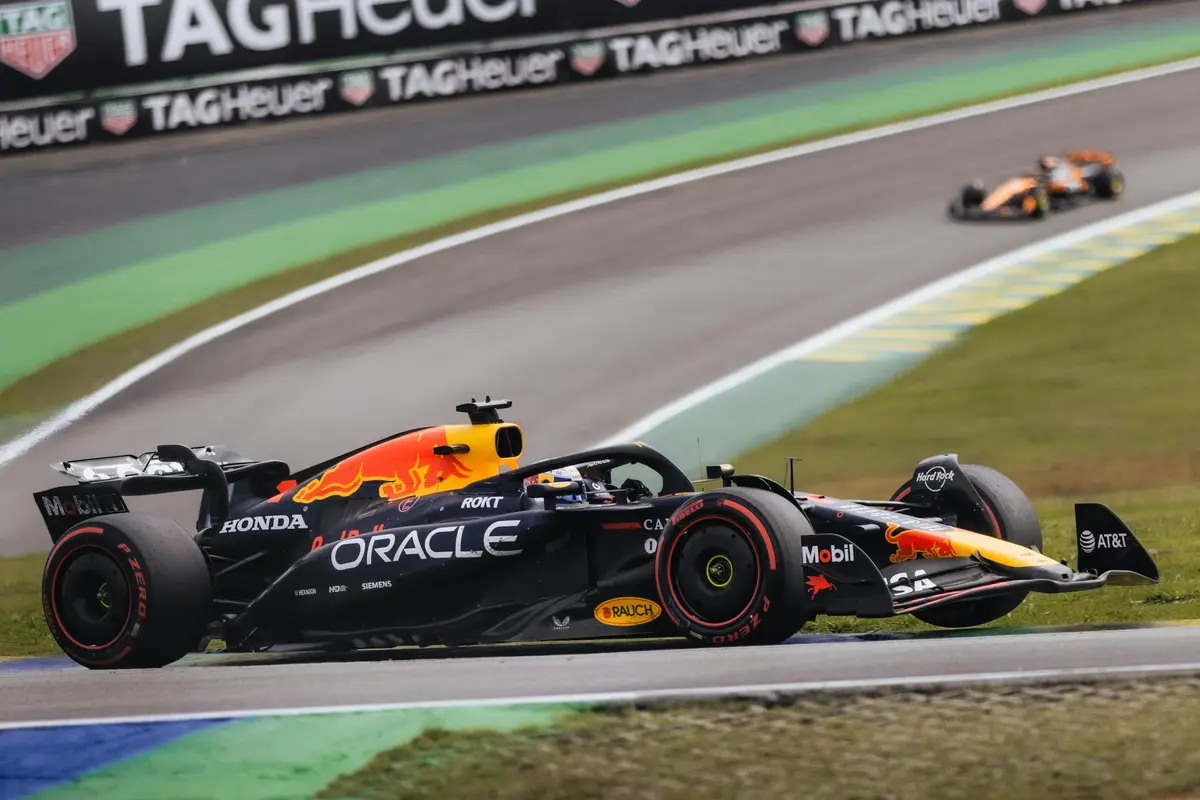
Red Bull Racing have sent a clear signal of intent to their 2026 Formula 1 rivals after unveiling a drastically revamped car at an unexpected spring break test at Silverstone. The headline development was a striking new rear wing design that has already been given a colourful nickname within the paddock: the 'Macarena'. With four-time champion Max Verstappen behind the wheel, the test represents one of the most significant mid-cycle development pushes Red Bull have undertaken in recent memory, and it comes at a time when every fraction of aerodynamic efficiency is worth its weight in championship points.
In the hyper-competitive environment of the 2026 F1 season — defined by a sweeping new regulatory framework, the introduction of active aerodynamics, and an overtake boost system that has fundamentally altered downforce philosophy — a rear wing overhaul of this magnitude demands serious scrutiny. Here is everything you need to know about Red Bull's Macarena rear wing, what it could mean for Verstappen's championship campaign, and why a private Silverstone test in spring signals that Red Bull are far from done developing their challenger.
What Is Red Bull's 'Macarena' Rear Wing?
Nicknames in Formula 1 technical circles rarely arise by accident. When engineers, journalists, and insiders start calling a component something as vivid as the 'Macarena,' it almost always signals that the part features an unusual, eye-catching geometry that sets it apart from anything seen before on the grid. While the precise aerodynamic specifications of the new rear wing remain proprietary to Red Bull, the nickname itself suggests a design with notable movement, curvature, or multi-element complexity — characteristics that are all the more relevant in 2026, when the active aerodynamic regulations have fundamentally changed how rear wings are allowed to behave at speed.
Under the 2026 technical regulations, teams have significantly expanded freedom to deploy moveable aerodynamic elements, particularly on the rear wing, as part of the new overtake boost system. This means a rear wing's performance envelope is no longer simply about achieving the optimal balance between straight-line drag and cornering downforce at a fixed setting — it must now perform efficiently across a range of positions, transitioning smoothly between high-downforce and low-drag configurations. A radical new wing concept, therefore, is not merely an incremental update; it is potentially a step-change in how Red Bull's car manages the entire aerodynamic operating window.
The choice of the 'Macarena' name — a reference to a dance characterised by fluid, sweeping arm movements — could hint at a wing profile that flexes, articulates, or presents a particularly dynamic visual signature at high speed, distinguishing it sharply from the more conservative designs seen on rival machinery. That Red Bull have chosen to debut it at a private test rather than a race weekend underlines the experimental nature of the concept and the team's desire to gather clean, uninterrupted data before committing to a race-weekend introduction.
Why Silverstone? The Strategic Choice of Test Venue
The selection of Silverstone as the venue for this spring break test is worth examining in its own right. The Northamptonshire circuit is one of the most aerodynamically demanding tracks on the Formula 1 calendar, combining genuinely high-speed corners — most notably Copse, Maggotts, Becketts, and Chapel — with the kind of long-radius, high-load sweeps that expose weaknesses in rear-end stability and downforce consistency. For a team looking to evaluate a rear wing overhaul under genuine stress conditions, Silverstone offers a near-ideal proving ground.
Private testing in Formula 1 is a carefully regulated activity, and teams must operate within strict limits governing the number of days, the age of the car, and the type of tyres permitted. The fact that Red Bull chose to deploy a 'drastically revamped car' — not just a wing specification swap, but a broader package of changes — suggests this was not a simple shakedown. Red Bull appear to have structured the test as a comprehensive aerodynamic evaluation, using the Macarena rear wing as the centrepiece of a wider correlation exercise between their simulation tools and real-world track data.
For Max Verstappen, the opportunity to drive a substantially revised package in a low-pressure, private environment also carries psychological and technical benefits. Unlike a race weekend, where every lap is scrutinised and any issue becomes a public story, a spring break test allows driver and engineers to iterate freely, make bold setup choices, and explore the outer limits of what the new components can do. Verstappen's direct feedback will be invaluable in shaping how — and when — the Macarena wing makes its competitive debut.
The 2026 Regulatory Context: Why Rear Wing Innovation Matters More Than Ever
To appreciate why Red Bull's Macarena rear wing is significant beyond the usual narrative of an upgrade package, it is essential to understand the 2026 regulatory landscape. This season represents the most transformative technical reset in Formula 1 since the 2022 ground-effect regulations, and perhaps since the V6 hybrid power unit era began in 2014.
The 2026 rules introduced a completely revised aerodynamic philosophy, pairing smaller, more efficient bodywork with a dramatically more powerful hybrid power unit. Crucially, the active aerodynamics regulations mean that rear wings are no longer passive structures — they are dynamic systems that must work in concert with the car's energy deployment strategy. The overtake boost system, which allows drivers to access additional hybrid power in defined circumstances, is directly linked to aerodynamic state, making the rear wing's behaviour in low-drag mode a key variable in the overall performance equation.
In this context, a team that develops a superior rear wing concept early in the season gains a compounding advantage: better straight-line performance from the low-drag configuration, better cornering stability from the high-downforce configuration, and a more efficient transition between the two. For Red Bull and Verstappen, who know the championship margins in 2026 are likely to be tighter than in recent dominant cycles, getting the rear wing right is not optional — it is central to the entire season strategy.
The timing of this test, described as taking place during an 'unexpected' spring break, also suggests that Red Bull identified a development need quickly enough to accelerate their testing calendar rather than waiting for a scheduled race-weekend introduction. In a season as technically fluid as 2026, that kind of responsive development culture can be the difference between title contention and frustration.
Verstappen's Role in the Development Programme
Max Verstappen's involvement as the test driver for this evaluation is telling in itself. As a four-time World Champion now in his second decade in Formula 1, Verstappen has developed a reputation not only as an exceptionally quick driver but as one of the sport's most technically articulate — a driver who can communicate the behaviour of experimental components with the kind of precision that accelerates the engineering loop significantly.
Red Bull's decision to put Verstappen, rather than rookie teammate Isack Hadjar, in the car for this specific test reflects the critical importance they are placing on the Macarena wing data. The feedback from a driver of Verstappen's calibre on a novel aerodynamic concept — particularly one that involves active aerodynamic behaviour under 2026 regulations — will carry enormous weight in determining whether the wing proceeds toward race introduction or returns to the wind tunnel for further refinement.
Hadjar, who was promoted from Racing Bulls for the 2026 season, will undoubtedly have his own development programme and will accumulate test mileage through the season. But for a targeted technical evaluation of this nature, Verstappen's experience and precision make him the logical choice.
Technical and Strategic Implications for Red Bull's Rivals
The news of this test will not have gone unnoticed in the garages at McLaren, Ferrari, Mercedes, and beyond. Each of Red Bull's major rivals is fighting its own technical battles in 2026: McLaren are seeking to build on the form that made Lando Norris a consistent title contender, Ferrari are managing the integration of Lewis Hamilton — now in his second year at Maranello — into their technical culture, while Mercedes are navigating the transition to Andrea Kimi Antonelli's second season as the team seeks to recapture their earlier regulatory-era dominance.
A significant rear wing overhaul from Red Bull signals that the team believes there is meaningful performance to be found in this area, which will prompt rivals to re-examine their own rear aerodynamic programmes. In the arms race of a technical reset season, one team's visible investment in a novel concept creates pressure across the paddock to accelerate equivalent or counter-development. The Macarena wing, whether it ultimately proves a success or a development dead-end, has already done competitive work simply by making its existence known.
Key Takeaways
- Red Bull debuted a drastically revamped car, headlined by the 'Macarena' rear wing, at a private spring break test at Silverstone.
- Max Verstappen was at the wheel, underlining the technical significance of the test and the importance of high-quality driver feedback for the new components.
- The 'Macarena' nickname suggests an unconventional, visually distinctive rear wing geometry suited to the 2026 active aerodynamics regulatory environment.
- Silverstone was chosen as the test venue, offering the high-speed, high-load aerodynamic challenge necessary to evaluate a rear wing concept under real-world stress conditions.
- The 2026 regulations — featuring active aerodynamics and an overtake boost system — make rear wing innovation a central axis of performance development this season.
- The timing of the test, described as 'unexpected' and conducted during a spring break, signals Red Bull's urgency and responsiveness in their development programme.
Frequently Asked Questions
What is the Red Bull 'Macarena' rear wing?
The 'Macarena' is the nickname given to a radically redesigned rear wing that Red Bull debuted on their 2026 F1 car during a private spring break test at Silverstone. The name suggests an unusual or highly distinctive aerodynamic profile. The wing was tested by Max Verstappen as part of a broader package of car revisions, though the precise technical specifications have not been made public by the team.
Why did Red Bull test at Silverstone during the spring break?
Silverstone's combination of high-speed corners and long-radius sweeps makes it an ideal venue to evaluate rear wing performance under genuine aerodynamic stress. Conducting the test during a spring break allowed Red Bull to work in a private, uninterrupted environment without the competitive pressure of a race weekend, enabling deeper and more experimental data-gathering. The test being described as 'unexpected' suggests it was accelerated in response to a specific development target.
How does the 2026 active aerodynamics regulation affect rear wing development?
Under the 2026 F1 regulations, rear wings are part of an active aerodynamic system that transitions between high-downforce and low-drag configurations, linked to the overtake boost system. This means teams must now engineer rear wings that perform efficiently across a dynamic range of positions, not just at a single fixed setting. Innovations in rear wing design therefore carry compounding performance benefits across both qualifying and race trim.
What does this test mean for Max Verstappen's 2026 championship prospects?
The test demonstrates that Red Bull are actively investing in significant aerodynamic development and are willing to conduct additional private testing to validate new concepts. Verstappen's direct involvement as the test driver signals the team's confidence in his technical precision and his central role in shaping the car's development trajectory. If the Macarena wing proves successful, it could deliver a meaningful performance step for Verstappen in a 2026 championship fight expected to be tightly contested.
Conclusion
Red Bull's unveiling of the 'Macarena' rear wing at a private Silverstone spring break test is a significant development story for the 2026 Formula 1 season. It speaks to a team that is not resting on the laurels of Max Verstappen's four championship titles, but is instead pushing hard to find performance advantages in a regulatory era that has reset the competitive order. The choice of Silverstone, the breadth of changes described as a 'drastically revamped car,' and the involvement of Verstappen himself all point to a targeted, high-priority development push.
In the context of 2026's active aerodynamics regulations and the overtake boost system, a superior rear wing concept is not merely a nice-to-have — it is a fundamental competitive tool. Whether the Macarena wing makes its race debut in the near term or undergoes further refinement before track introduction, the test has already demonstrated Red Bull's intent and their capacity to move quickly when they identify an aerodynamic opportunity.
For the rest of the grid, the message is unambiguous: Red Bull are developing, Verstappen is engaged, and the 2026 season's technical battle is very much alive. All eyes will now be on the next race weekend to see whether the Macarena rear wing makes its competitive bow — and whether it dances its way to the front of the grid.
In this article
Written with AI assistance. How this site works