McLaren MCL40 Development Philosophy Explained by Andrea Stella
Andrea Stella used a special McLaren factory event at Woking to outline the MCL40 development philosophy for 2026, doubling down on the in-season upgrade mastery that defined the team's 2023 and 2024 campaigns.
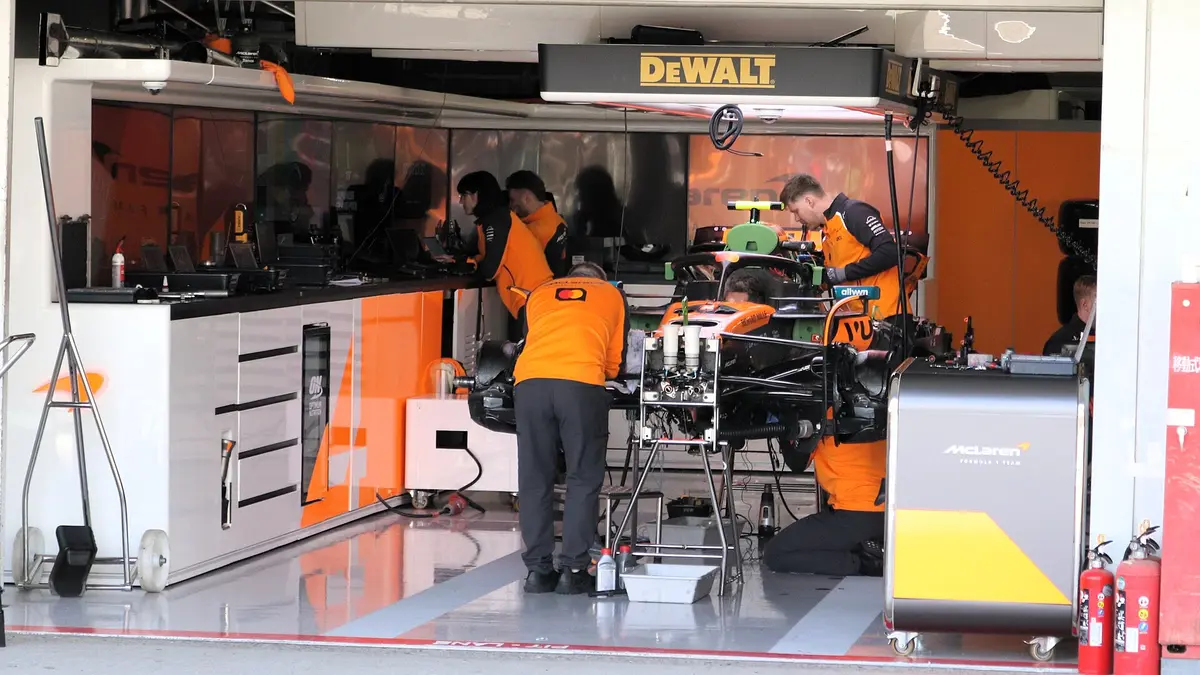
Photo: Liauzh / CC-BY-SA-4.0
McLaren's rise to the top of Formula 1 has been one of the sport's most compelling narratives of the mid-2020s. Central to that ascent has been the Woking-based outfit's remarkable ability to identify, develop, and deploy in-season upgrades with a precision that few rivals have been able to match. Now, as the 2026 season takes shape under a sweeping new technical regulation framework, team principal Andrea Stella has offered a rare and candid insight into how McLaren views its MCL40 — and what the team's development philosophy looks like heading into one of the most transformative eras in F1 history.
Speaking at a special media event held at McLaren's Woking factory, Stella used the platform to articulate his thinking on the MCL40 in terms that signal both confidence and measured ambition. For a team that has made in-season development its calling card, the framing of this new car matters enormously — not just for internal morale, but as a statement of intent to rivals, partners, and fans worldwide.
McLaren's In-Season Development Mastery: The Foundation of a Championship Contender
To understand what Stella's comments about the MCL40 truly mean, it is essential to appreciate the journey that brought McLaren to this point. In 2023, the team introduced an upgrade package that dramatically transformed its competitive position mid-season, vaulting Lando Norris and the then-McLaren lineup into genuine race-winning contention. The following year, 2024, McLaren refined and accelerated that same process, introducing performance upgrades early in the campaign that proved equally transformative — ultimately delivering results that cemented the team's status as a front-running force.
This capacity for in-season development is not accidental. It reflects a deeply embedded culture at McLaren's Woking Technical Centre — one that prioritises correlation between wind tunnel and track data, rapid prototyping, and a decision-making structure that allows the team to commit to and execute upgrade programmes without the bureaucratic drag that can slow larger, more hierarchical organisations. Stella, an engineer by background who spent many years at Ferrari before joining McLaren, has been instrumental in shaping this culture since taking on the team principal role.
The fact that Stella chose a special factory media event — rather than a race weekend paddock scrum — to speak about the MCL40 development philosophy is itself instructive. It suggests a deliberate, structured communication strategy: McLaren is setting a narrative around this car early, positioning it not as a reactive response to rivals, but as a proactive expression of the team's engineering vision for the 2026 regulations.
The MCL40 and the 2026 Regulatory Revolution
The 2026 season represents the most significant regulatory overhaul Formula 1 has seen in years. The introduction of new aerodynamic concepts — including the active aerodynamics framework and revised power unit architecture incorporating enhanced electrical deployment — has forced every team to rethink its design philosophy from the ground up. In this context, how a team frames its car at the start of the year is a meaningful signal of its engineering confidence.
For McLaren, the MCL40 is the product of an organisation that has been building toward this regulatory moment with deliberate intent. The question Stella addressed at Woking was not simply whether the MCL40 is fast — it is how McLaren plans to develop and evolve it across a season that promises to see significant performance convergence and divergence between teams as the new regulations are better understood. This is precisely the domain in which McLaren has proven itself most dangerous in recent seasons.
The 2026 rules reward teams that can learn quickly and adapt. Active aerodynamic systems, for example, introduce variables that teams are still learning to optimise in real-world race conditions. A team with McLaren's track record of rapid development iteration is, on paper, exceptionally well-positioned to exploit that learning curve faster than its rivals.
Stella's Language: Reading Between the Lines
When a team principal speaks at a curated factory media event, every word is chosen with care. Stella's decision to use this forum specifically to describe the MCL40 — rather than deflect or offer boilerplate optimism — suggests he is communicating something substantive about where the team stands in its development trajectory. Without the full text of his remarks available beyond the source excerpt, what is clear is that McLaren views in-season development not as a contingency plan but as a core strategic pillar.
This is a fundamentally different philosophy from teams that arrive at a season opener hoping their launch-spec car is fast enough to sustain a title challenge. McLaren is, in effect, treating the MCL40's opening specification as the beginning of a development conversation — one that Norris and Piastri will contribute to through their feedback across every session, and one that the Woking factory will respond to with the urgency and precision that has become the team's signature.
Norris and Piastri: The Driver Partnership Fuelling McLaren's Ambitions
Lando Norris, now in his eighth season with McLaren having joined in 2019, and Oscar Piastri, in his fourth year with the team since arriving in 2023, represent one of the strongest driver pairings on the 2026 grid. Both drivers are known for their technical acuity — their ability to provide nuanced, actionable feedback to engineers is a genuine competitive asset, not merely a marketing talking point.
In a season defined by new regulations that no driver has experience of at the F1 level, that feedback quality becomes even more critical. The teams that will unlock the potential of 2026-spec machinery fastest are those whose drivers can articulate what the car needs in terms of aerodynamic balance, power unit deployment strategies, and tyre management — all areas that are meaningfully different under the new technical framework.
McLaren's strength, as Stella has consistently emphasised throughout his tenure, lies in the integration between its driver lineup and its engineering structure. The factory event at Woking is, in many respects, a public expression of that integrated confidence: this is a team that knows how it works, trusts the process, and is signalling that the MCL40 is a platform it believes in as a development base for the 2026 campaign.
Technical and Strategic Implications for the 2026 Season
For rival teams — Ferrari with Charles Leclerc and Lewis Hamilton in his second year at Maranello, Red Bull with Max Verstappen and rookie Isack Hadjar, and Mercedes with George Russell and Andrea Kimi Antonelli — McLaren's stated confidence in its development machinery represents a meaningful competitive signal. Teams that arrive at the season with less correlation confidence between their simulation tools and real-world performance may find themselves playing catch-up not just in raw pace, but in the speed at which they can close gaps.
The 2026 season also features new entrants in Cadillac — with Sergio Perez and Valtteri Bottas — and Audi, rebranded from Sauber, with Nico Hulkenberg and Gabriel Bortoleto. These teams will be navigating an even steeper development learning curve, which means the established frontrunners like McLaren have a structural advantage in being able to devote more resource to performance iteration rather than fundamental car comprehension.
Stella's framing of the MCL40's development approach at a factory event — rather than reacting to on-track results — suggests McLaren intends to control the narrative of its 2026 campaign proactively, a strategic communication choice as deliberate as any upgrade package timing decision.
Key Takeaways
- McLaren team principal Andrea Stella used a special Woking factory media event to describe the MCL40 and the team's development philosophy for 2026.
- McLaren's in-season development capability — proven most significantly in 2023 and 2024 — is framed as a core strategic pillar, not a contingency plan.
- The 2026 regulatory overhaul, featuring new active aerodynamics and revised power unit rules, creates an environment where rapid development iteration is a decisive competitive advantage.
- Lando Norris and Oscar Piastri's technical feedback quality is a genuine asset as teams learn entirely new regulatory machinery.
- McLaren's proactive factory communication strategy signals confidence in the MCL40 as a strong development platform from the outset of 2026.
- Rival teams — including Ferrari, Red Bull, Mercedes, and new entrants Cadillac and Audi — face the challenge of matching McLaren's demonstrated ability to evolve a car across a season.
Frequently Asked Questions
What did Andrea Stella say about the McLaren MCL40 at the Woking factory event?
Stella used a special media event at McLaren's Woking factory to describe the MCL40 and articulate the team's development philosophy for the 2026 season. His remarks centred on McLaren's approach to in-season development, which has been one of the team's defining competitive strengths in recent seasons. The framing positioned the MCL40 as a car McLaren views with genuine development confidence heading into the new regulatory era.
Why is McLaren's in-season development capability so significant in 2026?
The 2026 regulations introduce fundamental changes to both aerodynamic philosophy and power unit architecture, meaning all teams are navigating relatively unfamiliar technical territory. Teams that can identify performance gaps and deploy upgrades rapidly — as McLaren has demonstrated in 2023 and 2024 — will have a structural advantage in closing performance gaps faster than rivals. In a season where the regulations are new for everyone, development speed is as important as launch-spec performance.
How does McLaren's driver lineup contribute to its development strength?
Lando Norris and Oscar Piastri are both regarded as technically literate drivers capable of providing detailed, accurate feedback to McLaren's engineers. This feedback loop between drivers and the Woking technical team is a crucial part of McLaren's development process, enabling the team to prioritise the right areas for upgrade packages. In a new regulatory environment, that quality of driver feedback becomes even more valuable.
How does the 2026 competitive landscape affect McLaren's strategic position?
With new entrants Cadillac and Audi joining the grid in 2026, and all established teams adapting to sweeping regulation changes, McLaren's proven development infrastructure gives it an advantage over teams still learning fundamental car characteristics. Ferrari, Red Bull, and Mercedes remain the primary championship rivals, but McLaren's track record of translating development work into race performance makes it a formidable competitor regardless of its launch-spec competitive position.
Conclusion
McLaren's decision to host a dedicated factory media event at Woking — and to use it as a platform for Andrea Stella to articulate the MCL40 development philosophy — is a deliberate act of competitive communication. It reflects a team that has not only discovered a winning formula in recent seasons, but one that is confident enough in that formula to make it the centrepiece of its 2026 narrative before results on track have had a chance to speak.
The MCL40 arrives in a season defined by change — new regulations, new teams, new power dynamics across the grid. But McLaren's core strength remains constant: the ability to judge what a car needs and execute the changes required faster and more accurately than the competition. In 2023, that capability changed the trajectory of the season. In 2024, it became the foundation of championship ambition. In 2026, with Stella openly discussing it at the Woking factory, McLaren is making clear that it intends to do it all over again — and perhaps even better.
For Norris, Piastri, and everyone at the Woking Technical Centre, the MCL40 development story is just beginning. And if McLaren's recent history is any guide, it is a story that rivals would do well to watch very closely.
In this article
Written with AI assistance. How this site works