Lewis Hamilton at Ferrari: The Complete 2026 Story
From the rushed "macarena" rear wing in China to his first Scuderia podium, a Tokyo F40 cameo and the hunt for a maiden Ferrari win, here is the complete Lewis Hamilton Ferrari 2026 year-two story.
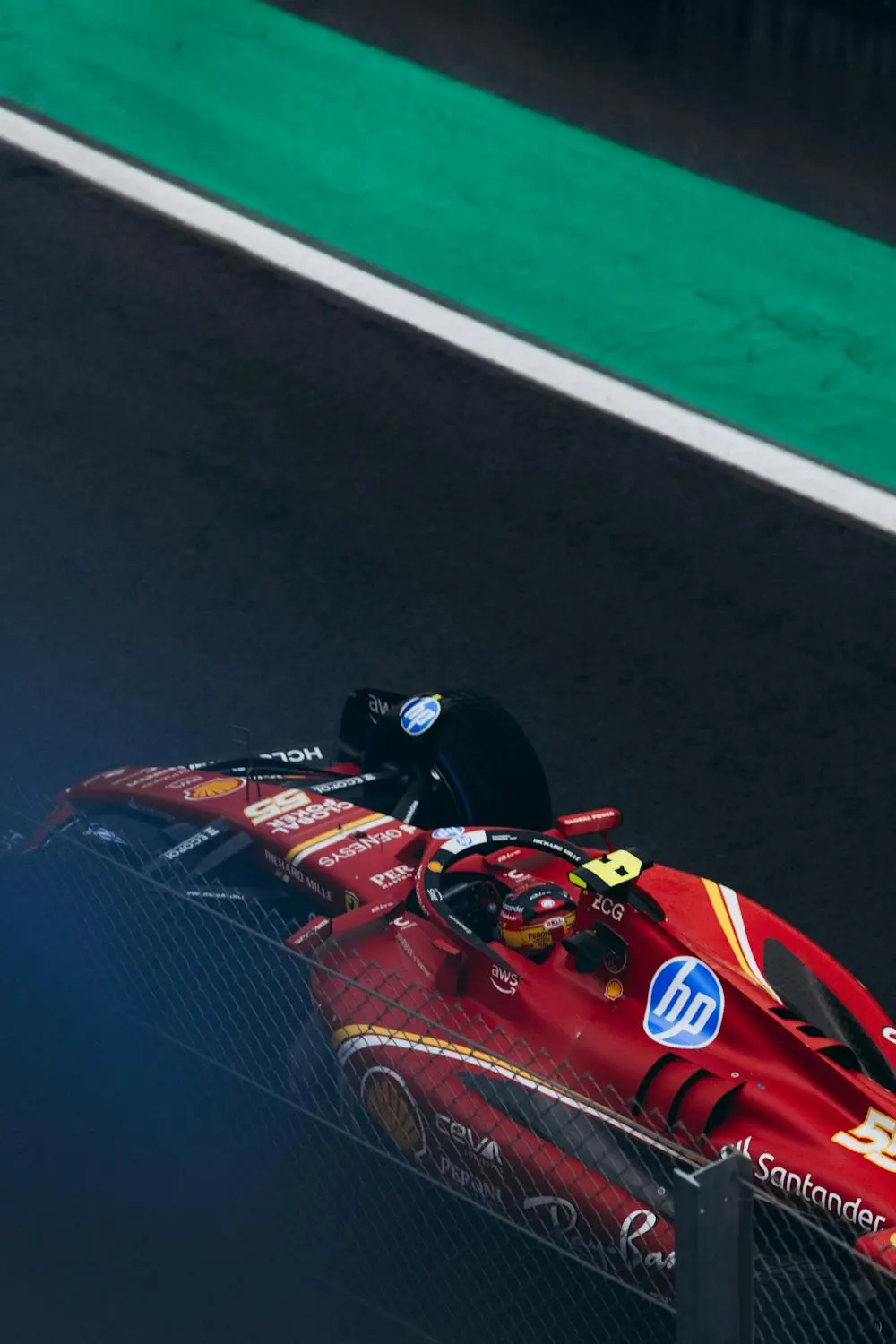
Twelve months ago, Lewis Hamilton Ferrari 2026 was still a headline about a transfer. In April 2026 it is something entirely different: a working partnership with a car, a race engineer, a first podium in red, and a very specific next target. Year two is where Ferrari hires are supposed to deliver, and Hamilton's second season in Maranello has already forced the Scuderia, their rivals and the Tifosi to recalibrate what good looks like for a seven-time World Champion driving a brand-new power-unit era.
This is the complete story of that year-two campaign so far — the SF-26 that arrived at winter testing, the controversial rear-wing gamble at the Chinese Grand Prix, the first Ferrari podium, the pre-Miami upheaval that rewired Hamilton's pit-wall relationships, the F40 drive through Tokyo that went viral on the way to Suzuka, the brand partnerships reshaping Hamilton's off-track life at Ferrari, and the single remaining box he has yet to tick in Scuderia colours: a grand prix win.
Year-Two Setup at Ferrari: Expectations and the SF-26
Year one was, by Hamilton's own standards, a bedding-in campaign. He arrived at Maranello mid-2024 in spirit and January 2025 in the seat, learned an Italian engineering culture from the inside, and accepted that a championship fight with McLaren was beyond the previous-generation Ferrari. The 2026 rules reset — brand-new power units with a roughly 50/50 split between internal combustion and electrical power, Active Aero in place of DRS, and a lighter, narrower chassis — meant year two was always going to be the one that mattered. Every team started broadly from zero. Ferrari, more than anyone else, needed Hamilton's feedback loop to count.
The SF-26 was signed off to a philosophy of aggression. Where Mercedes and Audi went for conservative, cooling-led packages, Ferrari chased peak aero efficiency with a tightly packaged sidepod, a long-wheelbase platform tuned for high-speed stability, and an Active Aero calibration that leans hard into low-drag mode through the middle of long straights. The early Bahrain test stints in February showed a car that was quick in a straight line and planted in medium-speed corners, but jumpy on kerbs. Hamilton's feedback — delivered, by his own admission, in a mix of English, broken Italian and gesture — centred on the car's pitch sensitivity as the rear wing transitioned between high-downforce and drag-reduction modes.
Expectations at Maranello were deliberately managed. Team principal Fred Vasseur set a public target of "regular podiums and no more podium droughts," with the unspoken understanding that Ferrari needed at least one driver in the top three on merit every other weekend to stay in the constructors' conversation. Hamilton's internal brief was simpler: find the car's limit and push Charles Leclerc. Leclerc, in year two of the partnership, entered 2026 as the nominal team leader on points but with no illusions about Hamilton's raw pace over a single lap once the SF-26 came alive.
Early-Season SF-26 Technical Trajectory
The first three rounds of the Lewis Hamilton Ferrari 2026 year-two story told a familiar Maranello tale: a quick car, but one that was still discovering itself. Australia produced a clean double-points finish but nothing spectacular. Saudi Arabia exposed the car's sensitivity to track temperature — Ferrari's aggressive aero calibration worked brilliantly at cool Jeddah night but forced the team to over-cool the power unit in the sprint session, blunting straight-line speed. Between rounds, Ferrari's aero department was already flagging that a midfield rear-wing concept was not going to be enough to consistently challenge McLaren.
That technical anxiety crystallised into one of the most talked-about upgrades of the early season: the so-called "macarena" rear wing introduced at the Chinese Grand Prix. The nickname — coined in the paddock after the wing's endplate and beam-wing elements appeared to "dance" as Active Aero cycled between modes on the main straight — stuck instantly. It was an aggressive, high-efficiency concept designed to run a bigger delta between downforce and drag modes than any rival on the grid. On its debut Friday in Shanghai, Hamilton was visibly faster in sector one but unsettled in the long, loaded Turn 13 right-hander, where the wing's transition caught the rear out in traffic.
Hamilton's post-weekend admission that the upgrade had been "rushed" was the defining technical quote of April. He was, characteristically, careful not to throw the aero group under the bus — instead framing the problem as a validation-versus-ambition trade-off. Ferrari had chosen ambition. The team pushed the wing through the wind-tunnel sign-off and into production without the full correlation programme they would normally run. The result was a genuinely fast piece of bodywork that required a driver of Hamilton's calibre to extract value from while the aero engineers hunted down the transient behaviour that was making the car inconsistent in medium-speed corners. It was, in Hamilton's words, "a rushed, brave call — and I respect that, because you cannot win in this era if you wait for perfect."
The technical trajectory out of China was positive. Ferrari committed to a follow-up aero package specifically targeting the macarena wing's transient behaviour, with revised beam-wing geometry and a new floor edge. That SF-26 update was confirmed for introduction at the next European round, with Hamilton publicly flagging it as the moment Ferrari would know whether their 2026 architecture could fight McLaren on pure pace or whether the season would become a damage-limitation exercise.
Chinese GP: First Ferrari Podium and the End of the Drought
The Chinese Grand Prix itself will be remembered less for the rear wing than for the result. Hamilton converted a difficult Saturday into a third-place finish on Sunday — his first podium in Ferrari colours since his debut season and, more importantly, the moment that ended an extended personal podium drought stretching back across the back half of 2025. The Shanghai breakthrough was not a lucky one. Hamilton qualified on the second row, defended hard against Mercedes' George Russell into the first Active Aero zone, and then managed his tyre degradation through a long middle stint that allowed Ferrari to pit him onto fresher hards with eleven laps to go. The undercut stuck. The podium was his.
The symbolic weight of that result inside Ferrari is difficult to overstate. A Scuderia driver on the podium is always news. A seven-time World Champion scoring his first top-three in red, on a weekend that involved a controversial upgrade, is a template for how Ferrari want Hamilton's 2026 to look: courageous engineering calls, exceptional racecraft, result on the board. In the post-race media pen, Hamilton was visibly emotional, thanking the Ferrari mechanics by name and describing the result as "the moment I felt Italian for the first time." That line — replayed across Italian television for 48 hours — did more for Maranello morale than any press release could.
Pre-Miami Upheaval: Race-Engineer Swap and the SF-26 Update
With the podium secured, Ferrari used the fly-away break to make two of the most consequential decisions of their 2026 season. The first was a race-engineer change on Hamilton's car. Reporting in the aftermath of Shanghai confirmed that the Scuderia had handed Hamilton a formal input into the choice of his race engineer ahead of the Miami Grand Prix — a rare gesture for a team historically known for a top-down, management-led structure. For a driver whose Mercedes partnership with his previous engineer had reached near-telepathic levels of shorthand, the ability to influence that decision at Maranello was significant.
The change, when it came, was framed by Ferrari as an optimisation rather than a demotion. Hamilton's original 2025 race engineer moved into a strategy-integration role, with a new voice — one with a stronger single-lap qualifying background — taking over on the pit wall. It was a pragmatic call. Hamilton's race-craft and tyre management are already elite; the area the partnership needed to find pace was qualifying, where Leclerc had consistently out-qualified him across the opening rounds. The internal logic was simple: pair Hamilton with an engineer whose calibration sweet-spot matches his weakest session.
Alongside the personnel change, Ferrari confirmed a major SF-26 update for the Miami weekend, first trailed in Hamilton's own media comments after China. The package included the revised beam-wing geometry, a new floor edge, and revised front-suspension geometry aimed at reducing the car's sensitivity to ride-height variation. Ferrari also confirmed a recalibrated Active Aero transition map, intended specifically to smooth the behaviour that had destabilised the macarena wing concept in Shanghai. Hamilton publicly called the Miami upgrade "the real start of our 2026 season," a line that neatly captured both the confidence inside Maranello and the pressure the team was placing on itself.
Japan Side-Story: The F40 Tokyo Run and a Refreshed Hamilton
Between Shanghai and Suzuka, the Lewis Hamilton Ferrari 2026 story briefly turned into a cultural moment. Hamilton arrived in Japan days before the Japanese Grand Prix and spent an afternoon driving a Ferrari F40 through Tokyo — a stylised marketing run coordinated with Ferrari Japan, filmed across the neon-lit streets of Shibuya and Roppongi, and posted to his social channels as a personal love letter to the Tifosi. The video exploded. Inside a week, it had become the most-shared piece of Ferrari content of the year and one of Formula 1's most-viewed off-track pieces of 2026.
Beyond the optics, the Japanese leg of the season had a noticeable effect on Hamilton himself. He spoke, on arrival at Suzuka, about the trip being "astonishing" and described a clarity of mindset he had not felt since the middle of 2023. He trained with a Japanese performance coach, spent an afternoon with a Ferrari-backed karting programme in Tokyo, and publicly linked his refreshed focus to the Japan visit. Senior Ferrari figures inside the paddock made a point of acknowledging the shift in energy. Year two, they said privately, had crossed a psychological threshold. Hamilton was not visiting Ferrari any more. He was Ferrari.
That energy fed directly into his Suzuka weekend — a track he rates as one of his three favourite in the world. The Japanese Grand Prix itself produced another strong points finish, with Hamilton extracting more from the SF-26 in the high-speed esses than the car's raw downforce figures suggested it should produce. It was the sort of drive that depends on mental freshness as much as car pace, and it underlined how much the Tokyo side-story mattered for the rest of the campaign.
Life at Ferrari: Brand Synergy and the Mercedes Prank-War Moment
Hamilton's off-track life in 2026 has, inevitably, been transformed by the Ferrari move. The Scuderia's commercial engine is different from Mercedes'. At Maranello, the driver is an extension of the brand in a way that has no equivalent anywhere else on the grid, and Hamilton's 2026 calendar has reflected that. Ferrari's own apparel line, a Tommy Hilfiger-linked capsule collaboration, a pair of luxury-lifestyle partnerships signed in the winter, and the F40 Tokyo run all fit into a single, coherent brand-synergy strategy that pairs Hamilton's global profile with the Prancing Horse's heritage. Even the rumour-mill stories — including widely circulated celebrity-adjacent speculation in the Italian tabloids — have been folded into Ferrari's commercial narrative rather than treated as distractions.
The most telling off-track moment of the year, however, was not commercial. In Bahrain pre-season testing, Hamilton found himself caught in a Mercedes prank-war — a light-hearted paddock episode coordinated by his former team, and picked up by Andrea Kimi Antonelli and Russell, that turned into one of the images of testing week. The prank itself was gentle. The significance was psychological. A year earlier, a similar episode would have been uncomfortable; in 2026, it was a sign that Hamilton had fully metabolised the transition. He was comfortable enough in Ferrari red to laugh about Mercedes, and Mercedes were comfortable enough in their post-Hamilton reality to joke back. It was, in its own small way, proof that the seven-time champion's Ferrari project had stopped being about leaving anywhere.
The Bigger Goal: First Ferrari Win
Every strand of the 2026 season — the SF-26's technical trajectory, the Shanghai podium, the Miami engineer change and upgrade, the Japan reset, even the Tokyo F40 run — points toward the same single unfinished target. Hamilton has yet to win a grand prix in Ferrari colours. That absence is now the defining question of his year-two campaign. In his own words, delivered with characteristic directness after Shanghai: "The podium is done. The hoodoo is history. The only thing left is the win."
The path to that first victory is more plausible than it has been at any point since his arrival. Ferrari now have a car that has delivered a podium, an aero department that has committed to a concrete update path, a driver-engineer partnership that Hamilton has directly shaped, and a teammate in Leclerc whose pace forces the team to keep sharpening the SF-26 rather than freezing development early. The competitive picture is unforgiving — McLaren's Lando Norris and Oscar Piastri have been the benchmark of the early season, Max Verstappen remains a threat in any Red Bull that works, and Russell's Mercedes is quietly the most consistent car on the grid — but that is exactly the kind of environment in which Hamilton has historically excelled. A clean weekend, a correct strategy call, a well-timed safety car and the arithmetic for his first Ferrari win snaps into place.
More importantly, Ferrari's internal structure is now organised around making that win happen. The team's decision-making has shifted from managing Hamilton's arrival to maximising his championship output, and every personnel, upgrade and communications call of the last six weeks has reflected that. Year two is no longer about integration. It is about conversion.
Key Takeaways
- Year two, not year one: Hamilton's 2026 is his second Ferrari season, and the expectations around him have shifted from integration to genuine championship contribution.
- SF-26 in development: The car arrived aggressive and quick but pitch-sensitive, with Ferrari already committed to a structured upgrade path through the opening European rounds.
- "Macarena" wing was a calculated gamble: Hamilton's own admission that the Chinese GP rear-wing package had been rushed captured Ferrari's willingness to take ambitious technical risks in 2026.
- Shanghai podium broke the drought: Hamilton's first Ferrari podium ended an extended personal podium drought and validated Ferrari's early-season direction.
- Miami brought a personnel reset: A Hamilton-influenced race-engineer change, plus a major SF-26 aero update, was framed internally as the true start of his 2026 season.
- Japan re-energised the campaign: The Tokyo F40 run and a broader cultural reset around Suzuka produced one of the sharpest mindset shifts of his Ferrari era.
- Off-track alignment is complete: Brand partnerships, the Ferrari apparel line and even a light-hearted Mercedes prank-war moment show a driver who is fully at home in red.
- The next target is singular: With the podium secured, Hamilton's 2026 is now defined by a single remaining question — when he takes his first grand prix win for Ferrari.
Frequently Asked Questions
Is 2026 Lewis Hamilton's first or second season at Ferrari?
2026 is Hamilton's second season at Ferrari. He joined the Scuderia for 2025 after leaving Mercedes at the end of 2024, so the 2026 campaign is his year-two season — the one in which expectations shift from integration to genuine championship contribution.
What is the "macarena" rear wing and why did Lewis Hamilton call it rushed?
The "macarena" rear wing was the aggressive Active Aero rear-wing package Ferrari introduced at the 2026 Chinese Grand Prix. It was nicknamed for the way its endplate and beam-wing elements appeared to move as the wing cycled between high-downforce and low-drag modes. Hamilton described the upgrade as "rushed" because Ferrari had prioritised ambition over full wind-tunnel correlation, producing a fast but transient-sensitive piece of bodywork that required further refinement.
When did Lewis Hamilton score his first Ferrari podium?
Hamilton's first Ferrari podium of the 2026 season came at the Chinese Grand Prix, where he finished third after a strong middle stint and a well-timed undercut pit-stop. It ended an extended personal podium drought and became a defining result of his year-two campaign.
Has Lewis Hamilton won a grand prix for Ferrari yet in 2026?
No. At the time of writing, Hamilton has not yet scored a grand prix victory in Ferrari colours. Following his first Ferrari podium at the Chinese Grand Prix, his explicit next target is a maiden Scuderia win, and Ferrari's personnel changes and SF-26 upgrade path are organised around making that result possible.
Conclusion
The Lewis Hamilton Ferrari 2026 story has matured from a headline transfer into a functioning, high-output championship project. The SF-26 is a car with genuine pace and a clear development runway. The Shanghai podium proved the car and the driver can produce results when the engineering risks pay off. The pre-Miami engineer change shows a Ferrari willing to adapt its internal structure around its seven-time World Champion. The Tokyo F40 moment and the broader Japan reset confirm a driver whose mindset is sharper than it has been in two years. And the off-track brand alignment — up to and including the Mercedes prank-war gag in Bahrain — tells the story of a fit that has fully settled into place.
What is left is the simplest, hardest thing in Formula 1: a race win. Every element of Hamilton's year-two campaign is now pointed at that single outcome. When it arrives, it will be one of the defining moments of the 2026 season and, in all probability, the moment the final chapter of Hamilton's Ferrari story truly begins.
In this article
Written with AI assistance. How this site works