Red Bull & Verstappen: The 2026 F1 Season
From the Bahrain pre-season optimism to the Shanghai flashpoint, the Red Bull Verstappen 2026 season has become the defining saga of Formula 1's new regulatory era. This pillar unpacks every thread: RB22 technical trajectory, Horner's shadow, Hadjar's arrival, Lambiase's McLaren move and what it all means for the four-time world champion.
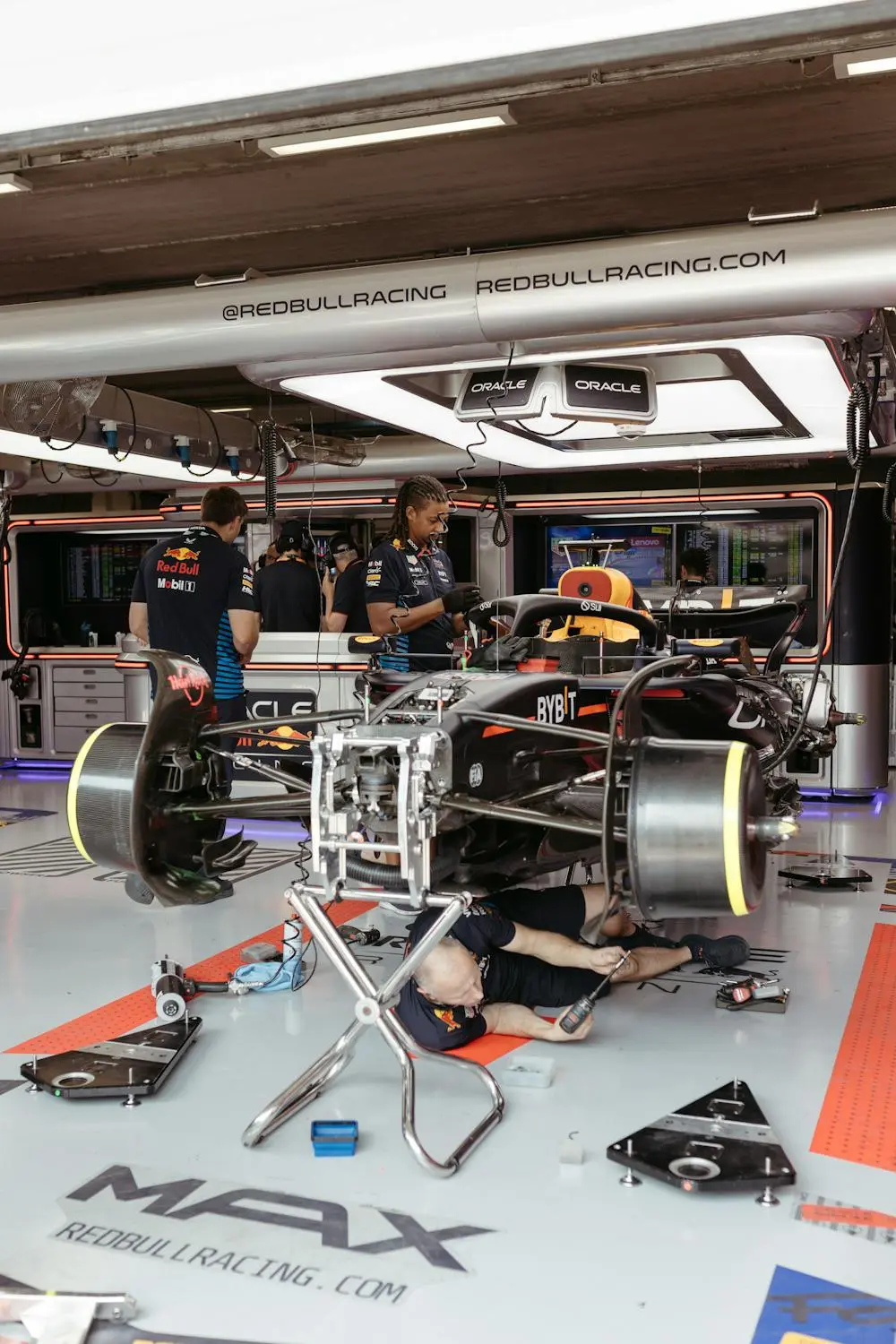
No storyline has dominated the opening months of Formula 1's new regulatory era quite like Red Bull Verstappen 2026. What started as a carefully choreographed reset in Milton Keynes, with a new team principal, a Ford-backed power unit and a French rookie slotting in beside the four-time world champion, has spiralled into one of the most scrutinised seasons of Max Verstappen's career. Pre-season confidence in Bahrain gave way to a sluggish opening in Melbourne, a qualifying crisis at Suzuka, a fractious Shanghai weekend that dragged the FIA into the team's affairs, and a steady drumbeat of off-track stories involving Christian Horner, Stefano Domenicali and the shock departure of race engineer Gianpiero Lambiase to McLaren.
This pillar pulls together every thread of the Red Bull Verstappen 2026 story so far. It is built from F1 Newsboard's on-the-ground coverage across pre-season testing, the Australian opener, the Japanese Grand Prix and the Chinese Grand Prix, as well as the stream of political and technical commentary that has swirled around the team since the 2026 regulations locked in. If you want the complete picture of how Red Bull Racing has handled the 50/50 power split, the active aerodynamics, the Manual Override and the relentless pressure of a title defence, this is the single reference to keep open.
Season Setup: Horner's Shadow, Jos's Advice and Red Bull's 2026 Rules Critique
Red Bull arrived at the Bahrain pre-season test with the most rewired organisation on the grid. Team Principal Laurent Mekies had taken formal control of day-to-day racing operations, a decentralised engineering structure had been implemented to cope with the new software-heavy regulations, and the Ford powertrain partnership was live in anger for the first time. Yet the biggest pre-season talking point had nothing to do with the car. The lingering shadow of former team boss Christian Horner, and the parallel media circus around his role, dominated the UK tabloid cycle even as Mekies tried to set a technical tone.
Inside the garage, the narrative that carried through from testing was the psychological one. Max Verstappen used a Thursday evening session in Sakhir to reveal a piece of advice from his father, Jos Verstappen, that has reportedly defined his entire career: the moment you feel you have mastered a car is the moment you become vulnerable. That philosophy of permanent dissatisfaction is tailor-made for the 2026 rules package, where drivers must juggle the new Manual Override boost, the active aero wing elements and energy deployment maps that change corner by corner.
Jos Verstappen was not just a quiet background voice. Publicly, he joined his son in questioning the 2026 rules, particularly the 50/50 split between internal combustion and electrical power, and the risk that energy management could become more decisive than racecraft. Red Bull's official line was more measured, but the family's willingness to criticise the direction of F1 set an early tone: this team was not going to pretend the new regulations were perfect, and it was prepared to say so in public.
Mekies, for his part, leaned into the technical reset. He framed 2026 as a year where Red Bull had to reintroduce itself to the grid on the back of a new engine partnership, and he repeatedly pushed the message that the team's performance would be judged by the end of the European season, not the opening flyaways. That framing would be tested almost immediately.
Technical Trajectory: Bahrain Day 3, RB22 Suzuka Upgrades and the Number Three Curse
On paper, Red Bull's technical trajectory through the early part of the Red Bull Verstappen 2026 season has been the most intriguing on the grid. Day 3 of the Bahrain pre-season test produced the headline lap time nobody in the paddock expected: a Verstappen long-run average that matched Ferrari on used tyres, despite the RB22 clearly running conservative engine modes. Red Bull's data analysts were particularly upbeat about the Ford-backed MGU-K's harvest rates along the long Sakhir straights, where rivals had struggled to avoid hitting the derating wall before the braking zones.
The RB22 itself is a fundamentally different car to anything Adrian Newey's Red Bull era produced. To accommodate the larger 2026 battery packs, the wheelbase has been stretched, the sidepod architecture has been simplified, and the floor has been tuned specifically around the reduced downforce ceiling mandated by the new rules. The active aero system, which allows the rear and front wing elements to move to reduce drag on straights and add downforce in corners, has been paired with a Manual Override button that Verstappen has taken to instinctively. Team engineers have spoken publicly about how his feedback on the Boost Button interface in Bahrain directly shaped the production spec.
By Suzuka, Red Bull had delivered the first major upgrade of the year. A reworked floor, new brake ducts and a small rear-wing tweak were introduced specifically to attack the Japanese circuit's unique demands: a long, fuel-hungry first sector followed by the medium-speed technical section through Degner and the hairpin. The upgrade was a technical success in clean air, but as we will see, the race weekend itself exposed a deeper problem that no amount of downforce could mask.
Running alongside the technical story was a superstition that would have felt trivial in any other season: the so-called number three curse. Verstappen's decision to continue carrying the champion's number one until he formally relinquishes the title has kept Red Bull off the number three that historically haunts the sport. But with rookies and cameo drivers rotating through the wider Red Bull stable, the number three narrative has been revived, with commentators pointing to Daniel Ricciardo's decline and Ricardo Patrese's 1978 infamy as cautionary tales. Red Bull has publicly laughed it off. Privately, engineers admit that a superstition becomes a story only when the results stop flowing, and in 2026 the results have not been flowing quickly enough.
Early Struggles: Slow Start, Suzuka Qualifying Crisis and the Shanghai FIA Ruling
The first on-track reality check of the Red Bull Verstappen 2026 story came in Melbourne. Verstappen qualified behind both McLarens and one Ferrari, and spent much of the race managing a car that was overworking its rear tyres on long runs. A podium was salvaged, but the gap to the front was larger than anything Red Bull fans had become accustomed to over the past three seasons. Mekies publicly acknowledged that the team had arrived underprepared for the specific tyre compound allocation at Albert Park, and that its simulation work had been skewed too heavily towards Bahrain-style high-energy tracks.
Suzuka turned concern into crisis. In qualifying, Verstappen was knocked out in Q2 after Red Bull aborted a final timed lap in anticipation of track evolution that never came. It was the kind of strategic misread that does not normally happen to Red Bull, and the post-qualifying footage of Verstappen stepping out of the car without speaking to his engineers circulated globally within an hour. Japanese fans, who have turned Suzuka into a de facto Verstappen home race, were visibly stunned. The race recovery drive to sixth was one of the most impressive performances of his career, but it only underlined how much absolute pace the RB22 was missing compared to the leaders.
Shanghai, two weeks later, brought the political dimension to the surface. In a tense opening stint, Verstappen and Alpine's Pierre Gasly made contact at the hairpin. Gasly, a former Red Bull junior and one of the drivers once pushed through the Red Bull system, publicly criticised the move on team radio. The FIA investigated, and while both drivers were ultimately cleared of causing a collision, the stewards issued a pointed ruling that emphasised the responsibility of lead drivers to leave space in overtaking zones under the new 2026 wheel-to-wheel guidelines.
The ruling itself was a procedural footnote. The reaction around it was not. Red Bull's messaging on team radio during the incident leaked and was replayed extensively, with Verstappen expressing frustration not just with Gasly but with the FIA's evolving interpretation of racing incidents. Within 24 hours, reports emerged of Formula 1 CEO Stefano Domenicali holding private talks with Verstappen, nominally about calendar and regulation matters, but widely interpreted as an attempt to manage the sport's most valuable asset through a volatile phase.
What made the early struggles harder to absorb was the context. Ferrari, with Lewis Hamilton now in his second season in red and partnered by Charles Leclerc, looked genuinely cohesive. Mercedes, with George Russell and Andrea Kimi Antonelli, had clearly solved the straight-line drag problem that defined their previous car. McLaren, with Lando Norris and Oscar Piastri, was operating at a level of consistency that Red Bull had owned a year earlier. Against that field, even small Red Bull errors were amplified.
Off-Track Drama: Driver Axing, Hadjar's Impressions, Lambiase to McLaren and Retirement Rumours
The early season's off-track drama has been just as consequential as the on-track results. The headline decision was the team's quiet defence of its brutal driver-axing culture. With Sergio Pérez's departure formalised at the end of 2025, Red Bull management publicly stood by the idea that the second seat must always be filled by performance, not sentiment. Mekies, pressed on the subject in Bahrain, pointed to the promotion of Isack Hadjar from the Red Bull junior system as evidence that the philosophy works: perform in a Red Bull-affiliated car and the senior seat will eventually open up.
Hadjar's own impressions of the 2026 car have been overwhelmingly positive. The Frenchman, stepping into the most scrutinised second seat in the sport, described the RB22 work as relentless and the engineering group as the most responsive he has ever worked with. Behind the scenes, his role has been more than a PR gift. Red Bull has tasked him with long-run data collection focused on the degradation patterns of the 2026-spec Pirelli tyres under the heavier cars, while Verstappen concentrates on energy mapping and race strategy. That division of labour has allowed Red Bull to compress its learning curve on a rules package where mileage equals understanding.
The most seismic off-track story, however, was the news that race engineer Gianpiero Lambiase, the voice behind Verstappen's championship runs and arguably the most important technical relationship in the driver's career, had signed for McLaren. The departure was framed internally as a long-planned career move rather than a political protest, but the timing was devastating. Losing the engineer who translates Verstappen's driving feel into car setup in the middle of a regulation reset is the kind of institutional blow that only large organisations can absorb.
Jos Verstappen, once again, inserted himself into the conversation. In a series of interviews, he questioned whether his son's long-term motivation could survive a sustained period of uncompetitive cars, and pointedly refused to rule out an early retirement scenario. Those comments coincided with the Domenicali private talks, and they collectively fed a retirement-rumour cycle that Red Bull spent most of the Chinese Grand Prix weekend trying to suffocate. The team's official position is that Max Verstappen is contracted, committed, and fully engaged. The paddock's reading is more nuanced: a driver who has won four titles does not need to stay in F1 to prove anything, and the 2026 rules have handed him a uniquely plausible exit story.
Management Tensions: Coulthard's Dismissal and Horner's Distractions
Inside the broader management picture, two distinct tensions have shaped the Red Bull Verstappen 2026 season. The first is the pushback against the team's more extreme criticisms of the new regulations. David Coulthard, the former McLaren and Red Bull driver turned paddock analyst, publicly dismissed the idea that the 2026 rules would be changed mid-season to accommodate complaints about energy management. His argument, which has gained traction, is that the FIA has built the 2026 package around a long-term sustainability roadmap, and that tweaking it now would be an overreaction to a handful of opening-round teething issues.
Coulthard's dismissal matters because it represents the mainstream paddock view. Red Bull's critique, echoed by Verstappen and Jos Verstappen, risked being characterised as sour grapes if the RB22 continues to lag behind the front. Mekies has clearly heard the message. By the Chinese Grand Prix, the team's public commentary on the rules themselves had softened noticeably, with senior figures instead emphasising the team's own development rate and playing down the likelihood of regulatory tweaks.
The second tension is the internal one. The Horner distraction story refuses to disappear. Every time a UK newspaper revisits the background details around his departure, the Red Bull garage is forced to respond, and every response risks pulling focus away from the technical fight. Mekies has tried to decouple operations from that media cycle, but the simple fact is that Horner's name remains attached to the Red Bull brand in the public imagination, and until the team wins again convincingly, that association will continue to colour the narrative.
The management picture is further complicated by the Ford partnership. Ford has brought serious resource to the battery and power electronics side, and its engineers now sit embedded in Milton Keynes. That integration has gone more smoothly than many feared, but it has also changed the decision-making culture. Red Bull is no longer a pure drinks-backed privateer with a single technical philosophy; it is now, functionally, a joint venture with a legacy American manufacturer. The 2026 rules have accelerated that evolution, and the organisation is still learning how to operate in the new mode.
What Verstappen's 2026 Means for Red Bull's Future
Strip away the drama, and the underlying question of the Red Bull Verstappen 2026 story is simple: does this season mark the start of a slow Red Bull decline, or is it a difficult transition year that ends with the team reasserting itself? The evidence so far points to transition rather than decline. The technical trajectory from Bahrain Day 3 to Suzuka upgrades to Shanghai race pace has been upwards. The Ford powertrain is clearly competitive. Hadjar is integrating faster than Pérez did in his final season. Mekies is managing the garage with a calmness the team has not seen for some time.
The risks, though, are real. Losing Lambiase to McLaren is not a small blow. The retirement rumour cycle is not going to stop until Verstappen personally stops it, and even then it will resurface at the first sign of a bad weekend. The FIA's wheel-to-wheel guidance under the 2026 rules is still being defined in real time, and Verstappen's aggressive style will continue to generate Shanghai-type flashpoints. And the competitive field is deeper than at any point since the hybrid era began.
The optimistic reading is that Red Bull has the resources, the driver and the organisational stability to turn the early deficit into a mid-season comeback. The pessimistic reading is that too many of the team's former advantages, including its race engineering continuity and its freedom from regulatory scrutiny, have been eroded simultaneously. Either way, the remainder of the 2026 season is going to be watched more closely than any Red Bull campaign in memory.
Key Takeaways
- Red Bull Verstappen 2026 is a transition season: new team principal, new power unit partner, new race engineer incoming, new rookie, new regulations. Every pillar of the past has changed simultaneously.
- The RB22 is competitive but not dominant: strong straight-line efficiency and Manual Override integration, but real weaknesses on tyre management and qualifying strategy calls.
- The Suzuka qualifying crisis and Shanghai FIA ruling exposed strategic and political fragility that Red Bull did not previously show under pressure.
- Off-track stories are consequential: the Lambiase move to McLaren, Horner's lingering shadow and Jos Verstappen's public interventions all feed the retirement rumour cycle.
- Hadjar is outperforming the second-seat baseline, and his long-run data role is accelerating Red Bull's learning curve on the 2026 Pirelli tyres.
- Coulthard's rule-change dismissal signals the paddock's mainstream view: the 2026 regulations are here to stay, and Red Bull will have to win within them.
Frequently Asked Questions
Is Max Verstappen actually going to retire in 2026?
There is no formal indication from Verstappen himself that he intends to retire during the 2026 season. The retirement rumours have been driven primarily by Jos Verstappen's comments about motivation under the new regulations and by Stefano Domenicali's private talks with the driver. Red Bull's official position remains that Max is contracted, fully engaged and focused on the title fight. Paddock observers expect the rumour cycle to continue until Verstappen addresses it directly.
Why did Gianpiero Lambiase leave Red Bull for McLaren?
Lambiase's move was framed as a planned career progression rather than a reaction to internal friction. McLaren's growing technical structure offered a senior engineering role that Red Bull could not match during a year of regulatory reset. The timing, coinciding with the new 2026 rules and Verstappen's difficult start to the season, is what has made the departure so significant. Red Bull is transitioning Lambiase's race engineering responsibilities internally, with continuity of communication style identified as the top priority.
What is the 'number three curse' and does it really affect Red Bull?
The number three curse is a long-running F1 superstition that links the number to a series of unlucky or career-damaging seasons, most famously Ricardo Patrese's 1978 campaign and Daniel Ricciardo's later decline. In 2026, with Verstappen retaining the champion's number one and the wider Red Bull stable rotating drivers, the number three story has been revived as a commentary device. Red Bull dismisses any direct effect. The relevance is narrative: when results dip, superstitions become stories.
How does the 2026 rules package affect Red Bull specifically?
The 2026 regulations introduce a 50/50 split between internal combustion and electrical power, a Manual Override button for overtaking boosts, and active aerodynamics that move the wing elements between low-drag and high-downforce modes. Red Bull, with its new Ford-backed power unit, has focused on energy harvest efficiency along long straights and on integrating Verstappen's driver feedback directly into the Manual Override interface. The team's publicly voiced concern is that energy management risks becoming more decisive than racecraft, a view Jos Verstappen has echoed and David Coulthard has dismissed.
Conclusion
The Red Bull Verstappen 2026 season is, so far, the most complete test the team and the driver have faced together. The Bahrain optimism has given way to hard evidence that the RB22 is no longer the benchmark car. The Suzuka qualifying crisis and the Shanghai FIA ruling have shown that the team's operational edge is under pressure. The Lambiase departure, the Horner shadow and the retirement rumour cycle have ensured that the off-track story is as loud as the on-track one. And yet the underlying technical direction, the stability under Laurent Mekies and the integration of Isack Hadjar all suggest a team that is transitioning rather than declining.
What happens next will define not just Verstappen's legacy but Red Bull's place in the new regulatory era of Formula 1. The European season will be decisive. Upgrades planned for Imola and Barcelona are expected to address the tyre management weaknesses, and the internal race engineering changes following Lambiase's announcement should be fully bedded in by then. If Red Bull emerges from that phase within touching distance of Ferrari, McLaren and Mercedes, the 2026 story becomes a redemption arc. If it does not, the retirement rumours will harden into a genuine strategic question. Either way, there is no storyline in Formula 1 more worth watching right now.
In this article
Written with AI assistance. How this site works