Mansell’s Interlagos Masterclass: The Williams FW14B Dominates Brazil
Nigel Mansell and the Williams FW14B were untouchable at the 1992 Brazilian Grand Prix, leaving the field—and Ayrton Senna—trailing at Interlagos.
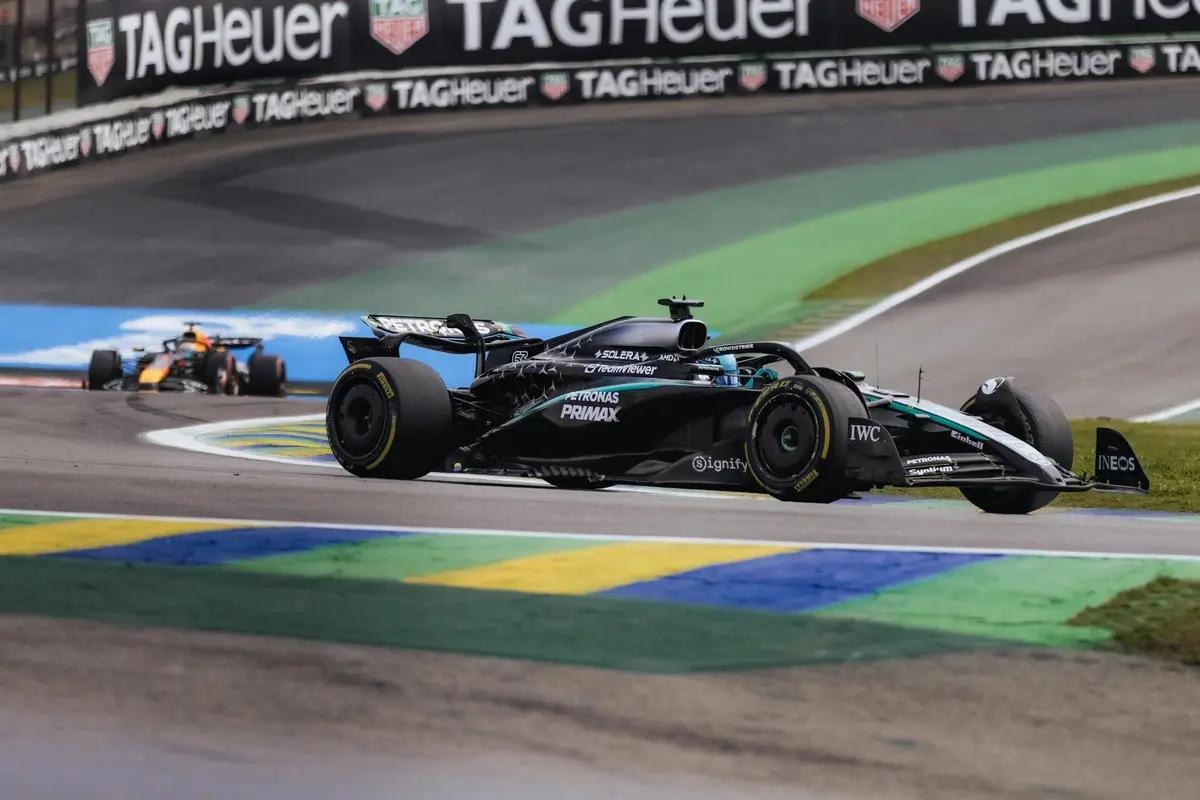
On This Day in 1992, Nigel Mansell secured a dominant victory at the Brazilian Grand Prix, driving the technologically advanced Williams FW14B. This win at Interlagos marked Mansell's third consecutive victory of the season, cementing the dominance of the Renault V10-powered machine and its revolutionary active suspension system over the rest of the field.
The Arrival of the 'Computer Car' at Interlagos
The 1992 season is remembered as the year the Formula 1 landscape shifted toward total electronic sophistication. On April 5, 1992, the paddock arrived in São Paulo for the third round of the championship. While the local fans were desperate for an Ayrton Senna victory, the sheer mechanical and aerodynamic superiority of the Williams FW14B was about to spoil the party. The car was so advanced compared to its rivals that many in the pit lane began referring to it as the 'car from another planet.'
Active Suspension and Renault V10 Power
The Williams FW14B, designed by the brilliant minds of Adrian Newey and Patrick Head, was a masterpiece of period engineering. Unlike its rivals, it featured a fully functional active suspension system that allowed the chassis to maintain a perfectly flat attitude through the bumps and high-speed curves of Interlagos. Paired with the screaming 3.5-liter Renault V10 engine, Nigel Mansell and Riccardo Patrese occupied a different stratosphere of performance.
In qualifying, Nigel Mansell was a staggering 1.1 seconds faster than his teammate Patrese, and over two seconds clear of Ayrton Senna’s McLaren MP4/6B. The race itself was a display of peak mechanical efficiency. Mansell got the jump at the start and never looked back, utilizing the car's superior traction to pull away from the pack with ease.
Heartbreak for Senna, Rise of Schumacher
For Ayrton Senna, the race was a struggle from the outset. His McLaren, still utilizing a transitional chassis and lacking the electronic wizardry of the Williams, suffered from severe engine mapping issues. To the profound disappointment of the Brazilian crowd, Senna was forced to retire on lap 17. The sight of the home hero climbing out of his car early only emphasized the gap between the reigning champions and the new technical standard set by Williams.
This opened the door for a young Michael Schumacher in the Benetton B191B. While the Williams cars crossed the line in a synchronized 1-2 finish—Nigel Mansell leading Riccardo Patrese by 29 seconds—Schumacher claimed a solid third place. It was a sign of things to come for the German, but on this day, the mechanical grip and electronic "brain" of the Williams FW14B were the undisputed kings of the road.
A Statement of Intent
Mansell’s victory in Brazil was his third straight win in as many races, a feat that had never been achieved at the start of a season until that point. It wasn't just a win; it was a demonstration of technical dominance that left rivals like McLaren and Ferrari scrambling for answers in an era defined by rapid technological advancement and raw, unshielded speed. The 1992 season was officially under the reign of the 'Lion' and his computer-controlled chariot.
#F1 #F1History #BringBackV10s #F1Tech
In this article